
The tl;dr Case of the Month: Warfarin
A note from the tl;dr team: Welcome back to our new case of the month series! So far, we’ve covered a couple of infectious diseases topics, some cardio, and a dabble of endocrine. If you’ve missed any of these cases, be sure to check them out below:
Now onto this month’s challenge: warfarin. From INR goals to drug-drug interactions to reversal and so on and so forth. Warfarin is a hefty topic that you’ll learn to love. And what better way to test yourself than with a case?
P.S. If you need a warfarin refresher before diving into this case check out some of our posts below:
Okay, ready to put your knowledge to the test? And remember, if you get a question wrong, keep scrolling to review the explanation and understand the “why”. Also, if there is a specific topic that you would like us to cover in a future case, feel free to reach out to me at josef@tldrpharmacy.com.
Meet Your Patient
Patient: YU
Age: 55 years
Sex: Female
Weight: 79.8 kg
Vitals: BP (132/86 mmHg), HR (88 bpm), RR (11 breaths/min), Temp (98.3 ℉), O2 Saturation (99%)
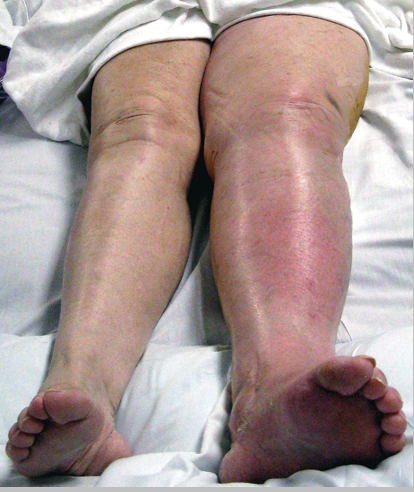
When your patient comes to you in clinic with legs looking like this, be suspicious. Be verrrrry suspicious.
Subjective: YU is a 55-year-old female who presents to your clinic from home c/o unilateral leg swelling and calf pain. She states that her symptoms have been ongoing for a couple of days and have not improved with ice and rest. She did confirm recent international travel with long layovers and flights.
Objective
Past Medical History: Generalized epilepsy, hypertension, hyperlipidemia, obstructive sleep apnea
Home Medications: Losartan 50 mg PO QD, Carvedilol 6.25 mg PO BID, Simvastatin 40 mg PO every evening, Carbamazepine 100 mg PO BID, Levetiracetam 750 mg PO BID, Acetaminophen 650 mg Q6H PRN pain
Allergies: eggs (anaphylaxis); NKDA
Assessment:
CBC: within normal limits
CMP: Creatinine (1.17 mg/dL), K (3.5 mEq/L); all other levels WNL
Venous Duplex Ultrasound: noncompressibility of the affected vein, consistent with an acute DVT
1) The medical team elects to initiate warfarin for treatment of an acute DVT. Which of the following represents the appropriate therapeutic INR range for this patient?
a) 1.5 - 2.0
b) 2.0 - 3.0
c) 2.5 - 3.0
d) 2.5 - 3.5
e) 3.0 - 3.5
2) Warfarin competitively inhibits vitamin K epoxidase leading to the decreased synthesis of which clotting factors?
(select all that apply)
a) Factor II
b) Factor IV
c) Factor VII
d) Factor IX
e) Factor X
3) Which of YU’s home medications may significantly alter warfarin’s anticoagulant effect? (select all that apply)
a) Carbamazepine; strong CYP enzyme inducer which may lead to subtherapeutic INR
b) Levetiracetam; strong CYP enzyme inhibitor which may lead to supratherapeutic INR
c) Simvastatin; strong CYP enzyme inhibitor which may lead to supratherapeutic INR
d) Carvedilol; strong CYP enzyme inducer which may lead to subtherapeutic INR
e) Losartan; strong CYP enzyme inhibitor which may lead to supratherapeutic INR
4) When initiating warfarin for treatment of YU’s acute DVT, which of the following is the most appropriate recommendation regarding bridging anticoagulation?
a) A bridge is not clinically necessary for the treatment of DVT and warfarin monotherapy can be initiated
b) Initiate enoxaparin 40 mg SC every 24 hours in addition to warfarin. Continue enoxaparin for at least 5 days AND until INR is therapeutic for at least 24 hours before stopping the bridge
c) Initiate enoxaparin 40 mg SC every 24 hours in addition to warfarin. Continue enoxaparin for at least 3 days AND until INR is therapeutic for at least 48 hours before stopping the bridge
d) Initiate enoxaparin 80 mg SC BID in addition to warfarin. Continue enoxaparin for at least 3 days AND until INR is therapeutic for at least 48 hours before stopping the bridge
e) Initiate enoxaparin 80 mg SC BID in addition to warfarin. Continue enoxaparin for at least 5 days AND until INR is therapeutic for at least 24 hours before stopping the bridge
5) Which counseling points should be provided to YU when initiating warfarin therapy? (select all that apply)
a) Avoid vitamin-K rich foods such as leafy greens when taking warfarin to maintain INR stability
b) Notify the healthcare team before starting new prescription medications, OTC products, or herbal supplements
c) If a dose is missed, double the next dose to maintain therapeutic anticoagulation
d) Report signs of bleeding such as black/tarry stools, blood in the urine, unusual bruising, or prolonged bleeding
e) For many major procedures with significant bleeding risk, warfarin is generally held approximately 5 days beforehand or as directed by your healthcare provider
6) Several months later, YU presents to the anticoagulation clinic for routine follow-up. Her INR is 4.1, and she denies any signs or symptoms of bleeding. Which of the following is the most appropriate recommendation?
a) Continue the current warfarin dose unchanged
b) Hold one dose of warfarin, then resume at a reduced maintenance dose and recheck the INR within several days
c) Hold one dose of warfarin, administer oral vitamin K 2.5 mg, then resume at a reduced maintenance dose and recheck the INR within several days
d) Hold one dose of warfarin, administer oral vitamin K 5 mg and 4F-PCC, then resume at a reduced maintenance dose and recheck the INR within several days
e) Hold one dose of warfarin, administer 4F-PCC, then resume at a reduced maintenance dose and recheck the INR within several days
Okay ready for the answers? Here you go:
1) B
2) A, C, D, & E
3) A & C
4) E
5) B, D, & E
6) B
Need More Warfarin NAPLEX Review?
Just a heads up here. This case should give you a pretty good idea of which warfarin pearls you need to know as you prepare for the NAPLEX. However, it’s NOT going to be an all inclusive guide to everything anticoagulation. If you want some more free educational reading, check our definitive guide to anticoagulation.
And if that isn’t enough, check out our anticoagulant/antiplatelet cheat sheet. For the cheap price of $9, you can get a 3 page cheat sheet that contains basically everything you need to know about anticoagulants AND antiplatelet medications. It goes over common dosing (by indication), dosage adjustments for renal and hepatic failure, drug interactions, reversal agents, hold times for procedures, pregnancy category, basic pharmacology, relevant clinical pearls, and a whole lot more.
And if you liked the format of our case series and want some more questions to test yourself, then check out our NAPLEX practice exam. This exam is the real deal. It has a total of 225 questions and is timed for 6 hours, just like the real exam. It’s as real as it gets, folks. And if you don’t score as high as you wanted and need some tutoring then sign up for an hour session through our private 1-on-1 NAPLEX tutoring. We really like to have our bases covered here at tl;dr pharmacy.
Okay, I digress. Let’s dive into the case now.
Review Time
When it comes to warfarin, there are a few big topics that you should get comfortable with if you want to ace the NAPLEX. These topics can include:
Goal INR depending on indication
Initial dosing and adjustment based off INR
Basic warfarin pharmacokinetics (onset of action, duration of action, etc) and mechanism of action
Drug-drug and food-drug interactions with warfarin. (And yes, this even includes herbal substances.)
When to bridge, why we bridge, how we bridge, and for how long
Different clinical pearls and patient education points
Reversal of warfarin
With that being said, let’s see how our case incorporates all these topics :)
Question #1: Indication for Warfarin and Goal INR
Warfarin is one of the oldest anticoagulants in the game and can be used to treat a hodge podge of blood disorders. Realistically, it’s fallen out of favor to the newer DOACs due to higher risk of bleeding, more drug and food interactions, and constant need for lab monitoring (PT/INR).
That being said, warfarin still holds its own as the anticoagulant of choice for certain blood disorders, including mechanical prosthetic heart valves, atrial fibrillation with moderate-to-severe mitral stenosis, and thrombotic antiphospholipid syndrome. And of course, your INR goal is going to change depending on the indication. Let’s review:
Nonvalvular atrial fibrillation: target INR 2.0 to 3.0
VTE (DVT/PE) treatment: target INR 2.0 to 3.0
Mechanical aortic valve: target INR 2.0 o 3.0
Mechanical mitral valve: target INR 2.5 to 3.5
Antiphospholipid syndrome (venous thrombosis): target INR 2.0 to 3.0
Antiphospholipid syndrome (arterial thrombosis): target INR 2.0 to 3.0 or 3.0 to 4.0
Antiphospholipid syndrome (recurrent thrombosis despite therapy): target INR 3.0 to 4.0
Our patient YU is being treated for an acute DVT. Therefore, her goal INR is 2.0 to 3.0. Does it make sense? Great!
Questions #2 & 4: Pharmacokinetics of Warfarin and Need for Bridge
To understand why, how, and when to bridge, it’s important we first review the pharmacokinetics of warfarin. Once we understand the “why” of warfarin bridging, the “how” becomes a breeze. So let’s take it back to the basics.
In your liver, there is a very important enzyme by the name of vitamin K epoxide reductase (VKORC1 for short). This VKORC1 helps recycle vitamin K back into its active form, which is then used by the liver to make functional clotting factors II, VII, IX, and X, as well as proteins C and S (more on proteins C & S in a bit). These clotting factors are then used in the clotting cascade to help your body form a clot. Kind of straightforward, right?
So where does warfarin come into play? Well, warfarin inhibits this VKORC1 enzyme, leading to a reduction in active vitamin K in the liver. Less active vitamin K available means less clotting factor production. Specifically clotting factors II, VII, IX, and X (answer to question #2).
Now onto the bridge portion. Remember how we said that warfarin inhibits clotting factors II, VII, IX, and IX, as well as proteins C and S? This right here is the key to understanding why we even bridge warfarin in the first place. We understand that clotting factors help our body clot. Reduction of these factors means less ability to clot. But what the heck are proteins C and S?
Believe it or not, proteins C and S are natural anticoagulation proteins made in the liver. It’s what keeps your body in check from excessively clotting to every minor injury you have. And yes, through its inhibition of VKORC1, warfarin inhibits the activity of these natural anticoagulants too. So where’s the problem? The half-lives of proteins C & S don’t directly match the half-lives of the vitamin K dependent clotting factors, putting your body in a brief pro-coagulable state.
Let’s take a look:
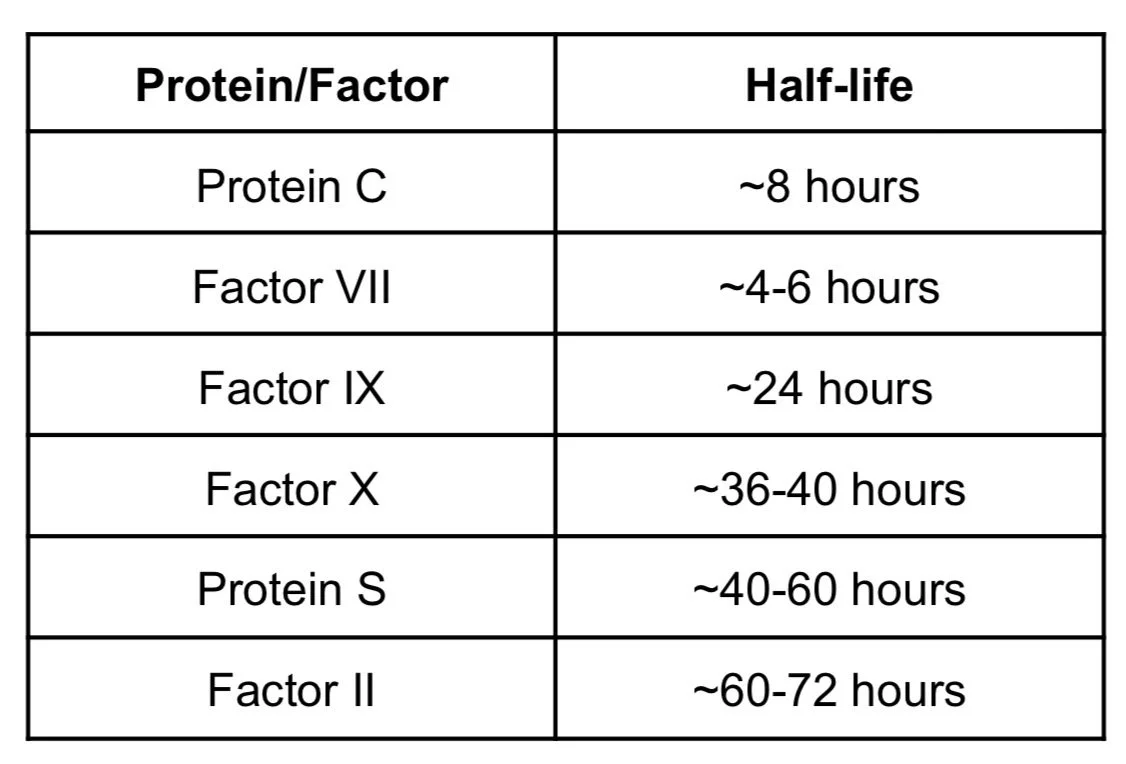
The most important comparison is protein C vs factor II. Protein C, which is an anticoagulant, disappears quickly after starting warfarin, while factor II hangs around for daaaaays (remember, 5 half lives to reach steady state). So when warfarin is acutely started:
Protein C ↓ quickly → anticoagulant protection drops
BUT
Factors II and X are still circulating → clotting potential remains
This mismatch can temporarily make the patient more prone to thrombosis, even though INR may already be rising. This is why when we're treating an acute clot, you overlap warfarin with therapeutic parenteral anticoagulation (typically enoxaparin or unfractionated heparin) until warfarin has had enough time to suppress the clotting factors with longer half-lives.
When it comes to bridging warfarin, it is recommended that patients be bridged with therapeutic parenteral anticoagulation for at least 5 days AND until the INR is therapeutic for at least 24 hours (answer to question #4). This gives the body enough time to overcome the long half-life of factor II and prevents the procoagulable state associated with new onset warfarin use.
Question #3: The Warfarin “Oh Shit” Drug Interaction List
We have a whole dedicated post about this that you can find here. To keep it short, I will give you a tl;dr version of what you need to know for warfarin and drug interactions. For starters, warfarin is a substrate of CYP2C9 (major), 1A2 (minor), and 3A4 (minor). Anything that messes with those enzymes will interact with warfarin. Inhibitors of those enzymes will increase warfarin concentration (meaning increase in INR) while inducers of those enzymes will reduce warfarin concentration (meaning decrease in INR). Here is a list of those big drugs that you should look out for:
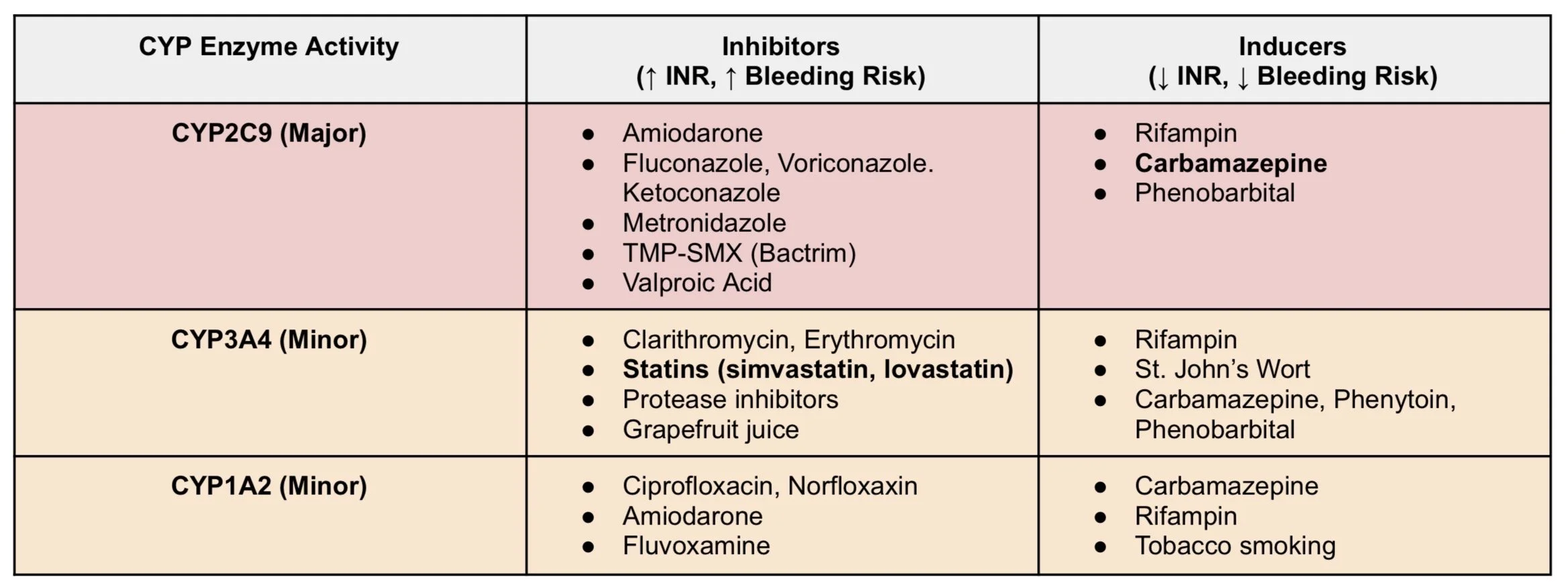
Now back to our question. Our patient is on carbamazepine, which is a strong CYP inducer and on simvastatin which is a CYP inhibitor. The carbamazepine will reduce warfarin concentration in the body leading to a decrease in INR, while the simvastatin will increase warfarin concentration in the body leading to an increase in INR. (The interesting part is seeing which drug interaction wins the tug of war in terms of effect on INR…)
Question #5: Warfarin Education

This, people, is why we have the internet. Also, eat your veggies.
At my old job, we used to have a little booklet that we gave patients whenever we provided warfarin counseling. It had all the important points to highlight when educating. I will keep it brief, but here is a summary of what you need to know:
Take warfarin exactly as prescribed at the same time every day
Keep all appointments for INR blood tests. Your INR tells us whether your warfarin dose is too high, too low, or just right
Do NOT double your dose if you miss one. If you remember the same day, take it when you remember. If it’s already the next day, contact your anticoagulation clinic for instructions
Keep your intake of food high in vitamin K consistent from week to week. You do NOT have to avoid green vegetables–you just want to avoid major sudden changes in how much you eat (Image)
Check with your pharmacist or healthcare provider before starting or stopping any medication, vitamin, supplement, or herbal products, including over-the-counter medications
Avoid NSAIDs such as ibuprofen and naproxen unless your healthcare provider specifically says they are okay, because they can increase your risk of bleeding
Limit alcohol and avoid binge drinking, which can increase your risk of bleeding and affect your INR
Tell your healthcare providers, dentist, and pharmacist that you take warfarin. Do NOT stop warfarin before a procedure unless you are specifically instructed to do so
Seek medical attention for signs of serious bruising and bleeding such as blood in your urine, black/tarry stools, vomiting or coughing up blood, bleeding that will not stop, or unusually heavy bleeding
Seek urgent medical attention if you fall or hit your head even if you initially feel okay
Warfarin can cause serious birth defects. Tell your healthcare provider immediately if you are pregnant or planning to become pregnant
Question #6: Warfarin Reversal
On to our last warfarin topic of the day: reversal. Typically speaking, warfarin reversal is ONLY indicated for patients with severe, life-threatening bleeding such a head bleed, GI bleed, etc. Having an elevated INR puts you at a higher risk for bleeding, but it doesn’t automatically mean you need reversal. Holding warfarin for a day or so is generally more than sufficient to reduce INR back to normal in patients with no signs of bleeding.
In our case, the patient had a supratherapeutic INR of 4.1 with no signs of bleeding. Therefore, the correct answer is hold the warfarin for a day or so, recheck INR, and then restart warfarin at a lower dose.
However, if the patient DOES have signs of a life-threatening bleed then acute reversal is needed. You have two main agents that you will give. Let's review.
4-Factor Prothrombin Complex Concentrate (PCC). As the name suggests, 4-factor PCC has 4 different clotting factors in it: factor II, VII, IX, and X. Wait a second. Aren’t those the exact same clotting factors that warfarin indirectly inhibits by its action on VKORC1? Yes. Patients taking warfarin are deficient in those clotting factors, so to reverse, we give you those same clotting factors exogenously to help the body clot and reverse the bleed.
The second agent we give is vitamin K. Why? Because warfarin inhibits VKORC1 and prevents the liver from using active vitamin K to make clotting factors. So, if we give vitamin K, it allows our liver to create new active clotting factors and reverse the bleed.
Amazing. I hope you now feel like a warfarin wizard. Well, folks, that’s all! Until next time.