
The tl;dr Case of the Month: Community Acquired Pneumonia
A note from the tl;dr team: If you weren’t already aware, we launched a new case of the month series not too long ago. If you want to test your HIV knowledge, check out our first case which can be found here.

While this is actually legit, we’re looking to give a different kind of shout out.
Since we started our case series with HIV, I figured it’d be nice to stick to the ID theme. Let’s be real. Most of us don’t like ID. But somehow, it follows us no matter where we are in our careers. Whether it’s the NAPLEX, rotations, or our jobs, infectious diseases continue to haunt us. Since we can’t seem to avoid it, let’s learn to master it. And no better way to prepare than with a case :)
P.S. If there is a specific topic that you would like us to cover in a future case, feel free to reach out to me at josef@tldrpharmacy.com.
BONUS NOTE: You hear from us every other week, but now we want to hear from YOU! In an effort to highlight and celebrate the meaningful work that pharmacists (and their learners) do, we would like to start a recurring post consisting of YOUR proudest interventions. Send a brief summary of your de-identified case stories to steph@tldrpharmacy.com for inclusion in our new pharmacy impact series! (Image)
Meet Your Patient
Patient: SS
Age: 67 years
Sex: Female
Weight: 82.1 kg
Vitals: BP (114/72 mmHg), HR (102 bpm), RR (31 breaths/min), Temp (99.3℉), O2 Saturation (94%)
Subjective: SS is a 67-year-old female who presents to your emergency department from home c/o cough, shortness of breath, fatigue, and chest pain associated with deep breathing. She denies any recent hospitalizations and exposure to sick contacts. She claims that symptoms have been ongoing for several days but appear to have gotten worse over the past 24 hours.
Objective
Past Medical History: HTN, HLD, GERD, TIA in 2020, and generalized anxiety disorder
Home Medications: Lisinopril 40 mg QD, Rosuvastatin 20 mg QD, Pantoprazole 20 mg QAM, Hydrochlorothiazide 25 mg QD, Aspirin 81 mg QD, Sertraline 50 mg QD, Hydroxyzine 50 mg TID PRN anxiety
Assessment:
CBC: 15.4 x10^3/uL; all other levels WNL
CMP: Sodium (135 mmol/L), K (3.4 mmol/L), Creatinine (1.28 mg/dL), BUN (22 mg/dL); all other levels WNL
Viral Panel: pending
Sputum Culture: pending
MRSA PCR: negative
Imaging (Chest X-Ray): Right lower lobe consolidation concerning for pneumonia (Image)
EKG: normal sinus rhythm with a prolonged QTc (525 ms)
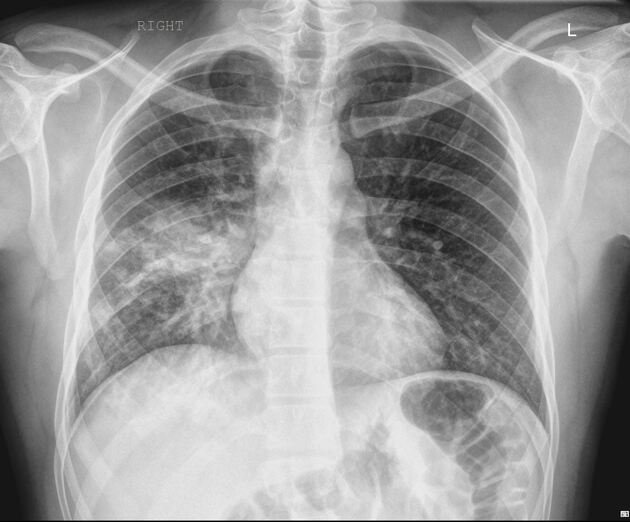
See that fuzzy, floating, whitish crud in the right lower lobe? That’s the “consolidation” concerning for pneumonia.
1) Based on the clinical presentation and objective data provided, which of the following is the most appropriate management strategy?
a) This patient has community-acquired pneumonia (CAP) and is appropriate for outpatient treatment with oral antibiotics
b) This patient has community-acquired pneumonia (CAP) and should be admitted for inpatient treatment with IV antibiotics
c) This patient has healthcare-associated pneumonia (HCAP) and is appropriate for outpatient treatment with oral antibiotics
d) This patient has hospital-acquired pneumonia (HAP) and should be admitted for inpatient treatment with oral antibiotics
e) This patient has hospital-acquired pneumonia (HAP) and should be admitted for inpatient treatment with IV antibiotics
2) Which empiric antimicrobial regimen is the most appropriate to start for this patient?
a) Levofloxacin
b) Cefepime + Azithromycin
c) Ciprofloxacin + Doxycycline
d) Piperacillin/Tazobactam + Vancomycin
e) Ceftriaxone + Doxycycline
3) After 48 hours, the respiratory culture comes back positive for Klebsiella pneumoniae (beta-lactamase positive). Which of the following interventions is the most appropriate at this time?
a) Stop current therapy and switch patient to monotherapy cefepime
b) Stop current therapy and switch patient to monotherapy ceftazidime
c) Stop current therapy and switch patient to monotherapy sulfamethoxazole-trimethoprim
d) Stop current therapy and switch patient to monotherapy ertapenem
e) Stop current therapy and switch patients to monotherapy daptomycin
4) According to the 2019 ATS/IDSA guideline, what is the minimum duration of treatment for community-acquired pneumonia in patients that achieve clinical stability?
a) 5 days
b) 7 days
c) 10 days
d) 14 days
e) 21 days
5) Which of the following bacterial pathogens commonly cause community-acquired pneumonia? (select all that apply)
a) Streptococcus pneumoniae
b) Pseudomonas aeruginosa
c) Chlamydia pneumoniae
d) Moraxella catarrhalis
e) Citrobacter koseri
Okay ready for the answers? Take a look below:
Answers:
1) B
2) E
3) D
4) A
5) A, C, & D
Need More Infectious Disease NAPLEX Review?
Just a heads up here. This is NOT going to be an all inclusive guide to infectious diseases. There is a lot more to ID than community-acquired pneumonia (I know, I wish it was that simple). But I have good news. Here at tl;dr, we like to have our bases covered. Here is everything infectious diseases that you may find helpful:
For starters, go to our website. In the top right you will find a little magnifying glass. Go ahead and click it. That should take you to our search bar (which can also be found here).
Using that search bar, you can literally type any common infectious disease topic that you can think of, and I can almost guarantee that we will have something on it. This can be anything from vancomycin dosing, UTI treatment, pneumonia, aminoglycosides, osteomyelitis, C diff, sepsis, endocarditis, and so much more. Seriously, just go ahead and search for it. I bet we have it. And if we don’t, shoot me an email at josef@tldrpharmacy.com, and I can make it happen :)
Who doesn’t love free things? I know I do. Check out our free antibiotic cheat sheet :)
If the cheat sheet isn’t enough, we have a whole infectious disease pocket guide that you can bring with you to rounds every day. It literally has everything you need to know about antibiotics.
And if all that still isn’t enough, then check out our NAPLEX practice exam and private 1-on-1 NAPLEX tutoring.
Okay I digress. Let’s get into the case now.
Review Time
When it comes to pneumonia, there are 4 main topics that you’ll likely get tested on. So please put them to memory. These topics include:
Differentiating CAP vs HAP vs VAP
When to treat CAP inpatient with IV antibiotics vs outpatient with oral antibiotics
Appropriate empiric treatment for CAP and which pathogens to cover
How long to treat
Questions 1 & 5: CAP vs HAP vs VAP
There are 3 different types of pneumonia that you have to remember. Knowing the origin is important because it helps us differentiate which bugs we need to empirically cover. Community-acquired pneumonia means more narrow coverage, whereas hospital/ventilator-acquired pneumonia means broader coverage against multi-drug resistant organisms. Let’s review.
Community-acquired pneumonia (CAP)
Definition: pneumonia acquired outside the hospital setting, diagnosed on admission or within 48 hours of hospital admission
Common Causative Pathogens:
Gram-positive: Strep pneumoniae, methicillin-sensitive Staph aureus, Strep pyogenes
Gram-negative: Haemophilus influenzae, Moraxella catarrhalis, Klebsiella pneumoniae
Atypical: Legionella pneumophila, Mycoplasma pneumoniae, Chlamydia pneumoniae
Hospital-acquired pneumonia (HAP)
Definition: Pneumonia not incubating at the time of hospital admission, occurring ≥48 hours after admission, and not associated with mechanical ventilation
Common Causative Pathogens: Methicillin-resistant Staph aureus, Pseudomonas aeruginosa, Acinetobacter, Enterobacteriaceae
Ventilator-associated pneumonia (VAP)
Definition: Pneumonia occurring >48 hours after endotracheal intubation
Common Causative Pathogens: Methicillin-resistant Staph aureus, Pseudomonas aeruginosa, Acinetobacter, Klebsiella, Enterobacter
Okay now back to question 1. Given the information we received, she just recently presented to the ED and denied any recent hospitalizations. Therefore, it’s pretty evident that this patient has community-acquired pneumonia as she does not carry any risk factors for HAP or VAP.
Oh, and one more thing. Health-care associated pneumonia (HCAP) is no longer a real thing. We treat those patients the same way we treat CAP. So if you see “HCAP” on an exam, you can automatically rule it out.
Now onto the second part of the question. Does she need to be admitted, or can she safely be discharged with oral antibiotics?
To determine that, we can use a couple different scoring systems. The IDSA recommends using the pneumonia severity index (PSI), which collects 20+ data points and makes an objective conclusion based on the results. However, most people use the CURB-65 score since it’s much easier and only takes into account 5 different data points. Let’s review.
CURB-65 Scoring (1 point each):
Confusion (new-onset)
Urea (BUN >19 mg/dL)
Respiratory rate >30 breaths/min
Blood pressure (SBP <90 mmHg or DBP <60 mmHg)
Age ≥65 years
Interpretation of Scoring:
Score 0-1: Outpatient treatment
Score 2: Short hospital stay or close observation
Score 3-5: Hospitalization
Using the information above, let’s calculate our patient’s CURB-65 score to determine the best course of action. Our patient was not confused, had a BUN of 22 (+1 point), respiratory rate 31 (+1 point), stable blood pressure, and is 67 years old (+1 point). Therefore, our patient has a CURB-65 score of 3 and should be hospitalized and treated with IV antibiotics.
Now regarding question 5, since this patient has community-acquired pneumonia, therapy should be more narrow and focus on the gram-positive, gram-negative, and atypical bacteria listed above. Pseudomonas and citrobacter are multi-drug resistant organisms and do not commonly cause CAP, thus making those answers incorrect.
Questions 2, 3, & 4: CAP Treatment
Okay, we now know that our patient has community-acquired pneumonia that should be admitted and treated with IV antibiotics. The next step is figuring out which antibiotics to empirically start.
The IDSA guidelines recommend one of the following regimens for the inpatient treatment of nonsevere CAP:
Beta-lactam (e.g., ceftriaxone, cefotaxime, ampicillin-sulbactam) PLUS a macrolide OR doxycycline
Respiratory fluoroquinolone (e.g., levofloxacin, moxifloxacin)
P.S. This is a common question that you’ll likely be tested on at one point or another. Ciprofloxacin is NOT a respiratory fluoroquinolone because it has poor coverage against Streptococcus pneumoniae. Since CAP is commonly caused by Strep species, cipro is NOT a good empiric choice to start. Stick with levofloxacin or moxifloxacin for pneumonia.
Now let’s go through each answer for question 2 to see why it’s right or wrong.
Monotherapy levofloxacin. While levofloxacin is a respiratory fluoroquinolone that can be used to treat CAP, this patient has a prolonged QTc of 525 ms. Fluoroquinolones are known to prolong QTc, and use would not be appropriate for this patient at this time.
Cefepime + Azithromycin. First of all, cefepime is a 4th generation cephalosporin that has broad gram-negative coverage. This patient does not have any risk factors for multi-drug resistant organisms such as Pseudomonas aeruginosa, and the extra broad coverage would not be appropriate at this time. Regarding the azithromycin, this patient has a prolonged QTc of 525 ms, and macrolides should not be used since they’re known to prolong QTc.
Ciprofloxacin + Doxycycline. Ciprofloxacin is not a respiratory fluoroquinolone since it has poor coverage against Strep pneumoniae. In addition, fluoroquinolones prolong the QTc, and their use would not be appropriate in this patient since she has a prolonged QTc of 525 ms at baseline. Lastly, fluoroquinolones provide good empiric coverage against atypical bacteria, and additional use of tetracyclines or macrolides for atypical coverage is not needed.

Piperacillin/Tazobactam + Vancomycin. Like we’ve already talked about, this patient does not carry any risk factors for multi-drug resistant organisms such as Pseudomonas aeruginosa or methicillin-resistant Staphylococcus aureus. Therefore this regimen is way too broad and would not be appropriate to start as empiric therapy for CAP. This regimen is more commonly seen when treating HAP and/or VAP in patients that are at risk for these multi-drug resistant organisms. (Image)
Ceftriaxone + Doxycycline. This leaves us with the only right answer. Per the IDSA CAP guidelines, a beta-lactam PLUS macrolide OR doxycycline is recommended. Since this patient has a prolonged QTc, doxycycline is preferred over a macrolide for atypical coverage.
Now on to question #3. We now have respiratory culture results positive for beta-lactamase producing Klebsiella pneumoniae. If you see beta-lactamase positive, then you can automatically conclude that the species is ESBL. And if you don’t remember, ESBL bacteria develop extrinsic resistance to all penicillins and cephalosporins.
The treatment of choice for ESBL is carbapenems. Put that to memory. Anytime you see ESBL anything, your brain should automatically think of carbapenems. Looking through our answers, only answer D has a carbapenem (ertapenem), thus making it the correct answer.
And last but not least, question #4. According to the 2019 ATS/IDSA guidelines, the standard duration of antibiotic treatment for community-acquired pneumonia (CAP) is a minimum of 5 days, with treatment continued until the patient has been afebrile and clinically stable for at least 48 hours. Since our patient has remained hemodynamically stable and is afebrile, a total 5 day course of therapy would be appropriate.
Well folks, that’s all she wrote! I hope you learned something from this case. If you have any recommendations for future case topics, please feel free to send me an email at josef@tldrpharmacy.com. And again, send your de-identified intervention stories to steph@tldrpharmacy.com!