
The ABCs of QTc for Pharmacists
Steph’s Note: This week, we’re going to touch on a subject that (I’d hazard a wager!) reaches pharmacists in pretty much every area of practice. And it’s one that we love to throw around and use to make interventions…but it’s also one that’s a little nebulous. Which is a rather tricky wave to ride. So let’s circle the wagons and make sure we’re all on the same page, while also digging below the surface level intervention of, “That drug prolongs the QTc.”
N.B. We’re going to do this in case-based format for funsies. But unlike our recent cases, it’s going to be from an outpatient pharmacy perspective in honor of my current practice, when you don’t have all the information at your fingertips…
Meet Your Patient
Patient: LR
Age: 91 years
Sex: Female
Weight: Unknown
Vitals: Unknown
Subjective: LR is a regular patient at your pharmacy, and today, her physician sends a new script for levofloxacin 500mg PO daily for 10 days.
Objective
PMH: No list available
Home Medications: Patient has regularly filled the following: amiodarone 100mg PO daily, atorvastatin 40mg PO daily, metoprolol succinate 50mg PO daily, apixaban 2.5mg PO BID, tamsulosin 0.4mg PO daily
Additionally, you notice that the patient has filled 2 rounds of cefdinir 300mg PO BID in the past 3 months.
Allergies: NKDA
Assessment
To borrow from Shakespeare, “To fill the levofloxacin, or not to fill the levofloxacin. That is the question!”
What potential causes for concern do you have regarding the use of levofloxacin in this patient?
a. QTc prolongation
b. Tendon rupture
c. Renal impairment
d. All of the above
What is the major arrhythmia associated with prolonged QTc?
a. Torsades de Pointes
b. Ventricular fibrillation
c. 2nd degree heart block
d. Atrial fibrillation
What constitutes a prolonged QTc?
a. >350ms in any patient
b. >400ms in any patient
c. >450ms in males and > 460ms in females
d. >550ms in any patient
What are non-modifiable risk factors for prolonging the QTc? (Select all that apply.)
a. Obesity
b. Female sex
c. Advanced age
d. Renal impairment
e. Structural heart disease
What are modifiable risk factors for prolonging the QTc? (Select all that apply.)
a. Hypokalemia
b. Hypomagnesemia
c. Use of multiple medications that prolong the QTc
d. Drug-drug or drug-food interactions
e. Hypocalcemia
Ready for the answers? Here you go:
D
A
C
B, C, D, E
A, B, C, D, E
Time to Dig a Little Deeper
Perhaps we should back up just a smidge since we’re making sure everyone is on the same page! What is the QTc again?
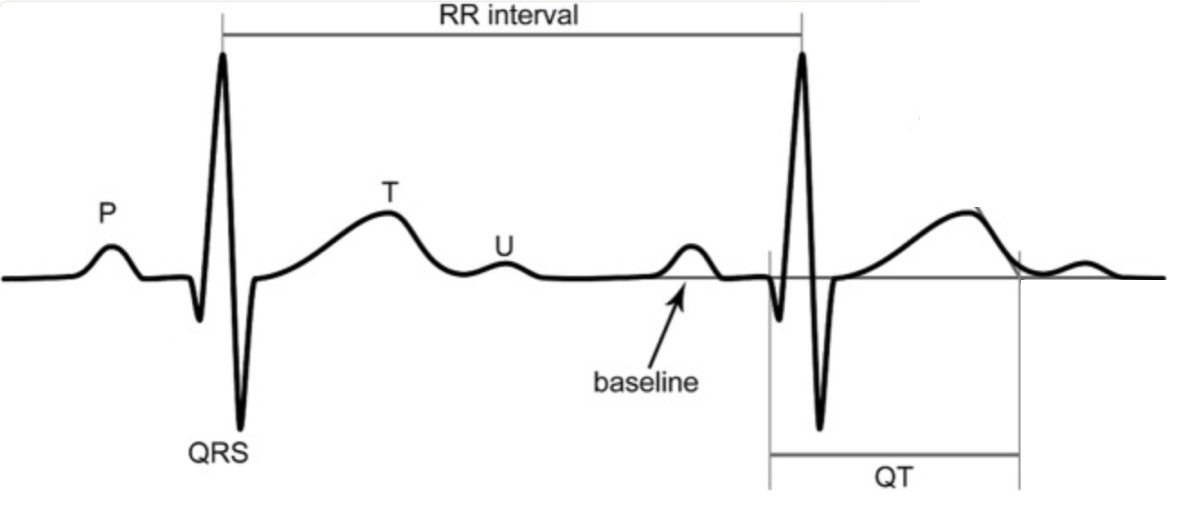
Remember the cardiac wave sequence on an EKG: P wave for atrial depolarization, QRS complex for ventricular depolarization, and the T wave for ventricular repolarization. The QT interval is the time between the Q wave and the T wave. Generally, it should be less than half of the R-R interval. Check out the image below for you visual folks (Image):
So if we’re talking about the QT interval, why is this entire post about prolonged QTc? What’s the “c”?
That stands for “corrected" QT interval, and this correction is done for the patient’s heart rate. As you might imagine, if a patient’s heart is beating rapidly, the QT interval will naturally shorten. Conversely, if their heart rate is slow, their QT interval will lengthen. However, trying to assess risk of arrhythmias with a constantly fluctuating QT is difficult - nigh impossible - which is why there have been multiple formulas developed to correct the QT for heart rate. Each of these seeks to standardize the measured QT for a heart rate of 60 beats per minute.
You can think of this as being similar to the differences between PT and INR. PT is the measurement, INR is the standardization so that we can compare apples to apples.
Happily, most EKG machines do the correction for us and report a QTc rather than a plain QT. Of course, there are scenarios where this automatically generated QTc is not reliable (why couldn’t it just be easy…). Notably, these unreliable situations include extreme heart rates (fast AND slow), atrial fibrillation, and T wave abnormalities (hard to determine a QT if the T isn’t regular or visible). So make sure you’re considering these factors when you look for the calculated QTc on an EKG strip.
Remember when I said this topic is somewhat nebulous? Well, that’s your first example of it. Even just trying to determine what a person’s QTc interval is on an EKG isn’t straight-forward! Not only can it fluctuate as a measure, but then organizations haven’t yet determined the best method for correcting it.
Now, onto the second nebulous point. Not only is there not consensus on how to correct a QTc and get a solid measurement, the medical community also hasn’t fully agreed on what constitutes a prolonged QTc. Yup, you read that right.
The AHA recognizes prolonged QTc intervals as >450 milliseconds (ms) for males and >460ms for females (Question 3), but other publications may put this at 470ms and 480ms, respectively. What most organizations and clinicians do agree on is that >500ms for any patient definitely increases the risk of Torsades de Pointes (TdP). It’s also been shown that every 10ms increase in QTc interval contributes to an increase in risk of TdP, so it’s a risk that builds in increments, not all or nothing. Many clinicians also recognize a change in QTc of at least 60ms from baseline as significant after a new treatment is started.
Having a prolonged QTc >500ms increases the risk of Torsades de Pointes (TdP) 2 to 3 fold! (Question 2) Each 10ms increase in QTc contributes to a 5-7% increased risk of TdP, so don’t forget that the risk builds incrementally as well.
What is this dreaded Torsades de Pointes (TdP), or “twisting of the points” rhythm? While uncommon, TdP is a form of polymorphic ventricular tachycardia that can degenerate to ventricular fibrillation and lead to sudden cardiac death. (Image)
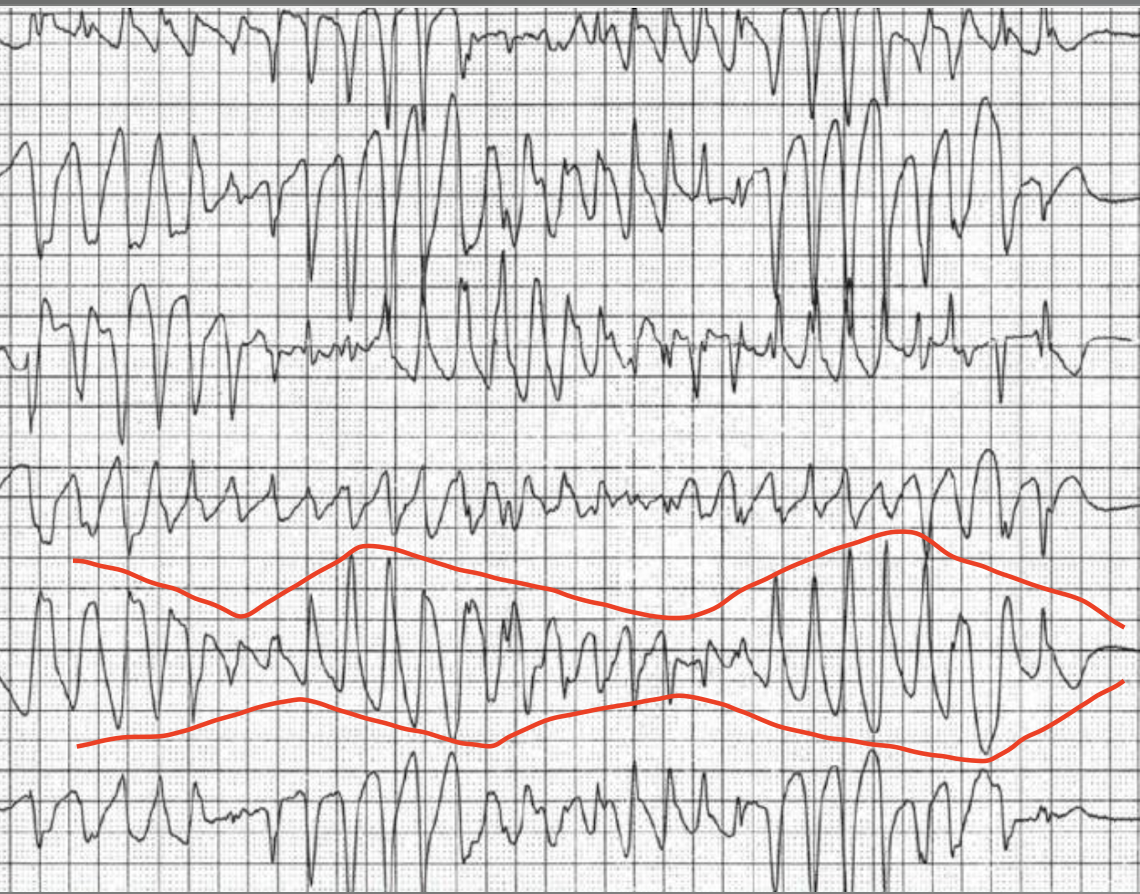
An EKG showing TdP. The red lines have been added to show you how the amplitude of the signals goes from larger to smaller to larger to smaller. This change is what makes it look like the EKG tracing is a helix that is “twisting”, giving the rhythm its characteristic name.
Alright, so we’ve discussed what QTc is, how to find it (or at least our best estimate), when it’s prolonged (or at least our best consensus), and why we care (TdP). We’ve talked about how risk of TdP increases incrementally with prolonged QTc rather than being an all or none issue when it crosses the threshold of 500ms. Now it’s time to talk about other factors that increase risk and which pieces we may be able to affect.
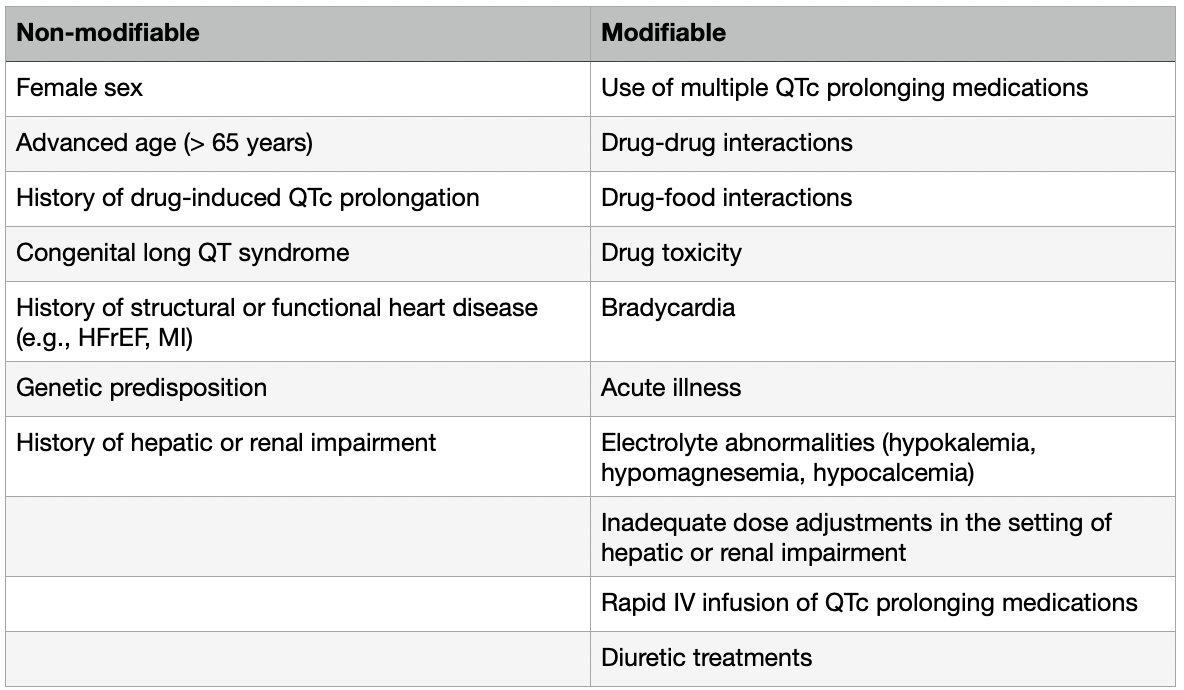
It’s long been recognized that there are modifiable and non-modifiable risk factors that can contribute to risk of prolonged QTc. To make this easy, check out the chart below (Questions 4 & 5):
Let’s dive a little more into the first modifiable risk factor: use of multiple QTc prolonging medications.
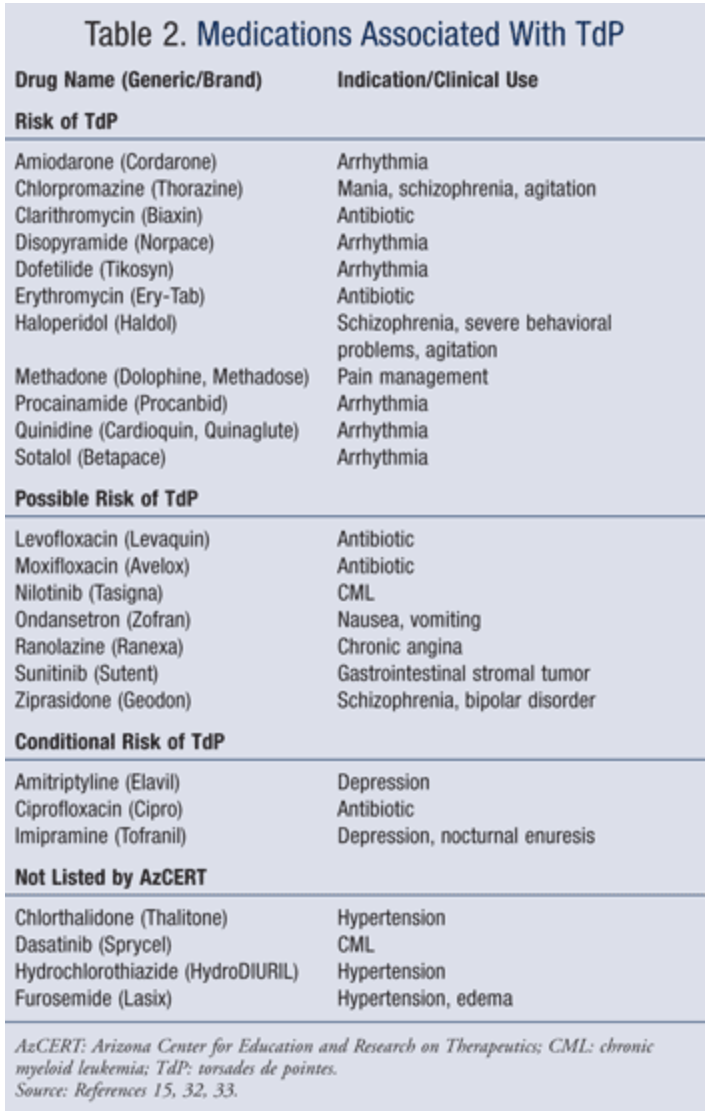
There are loads of medications that carry a risk of QTc prolongation, and it’s been an ongoing effort to try to delineate which are high vs medium vs low risk. Here’s that nebulous part again… Even if we think a medication is low to medium risk in and of itself, we don’t have really any way to quantify how that risk changes when we start adding other prolonging medications.
Does 1 + 1 = 2, or does it become a situation of 1+1 = 3? Or 5!? We just don’t know! The only thing we really know is that QTc prolongation risk increases as you increase the number of potentially offending medications.
What are those medications? (Image)
This list is by no means all-inclusive! (You should see another list here of just chemo agents and supportive care…) But it is enlightening to see that multiple classes of medications are on this list, and each member of a class can belong to a different risk level.
Did I say nebulous already? Oh yeah, I did.
So thinking back to our patient that started this case, even though we don’t have all the information we’d like to have, we do know she has several risk factors for QTc prolongation. These include her age, the fact that she’s female, her use of amiodarone, and now her new script for levofloxacin on top of that. Given that she is 91 years old, it’s also entirely possible that she has some degree of renal impairment, making the ordered dose of levofloxacin an additional issue for QTc prolongation as well as other adverse effects. (Question 1).
What’s your next step as the pharmacist here? What would you do?
Personally, I think it’s time to call the prescriber! When I did, turns out her last EKG demonstrated a QTc of 500ms (with a heart rate of 82 in normal sinus rhythm). Her electrolytes were thankfully in range, providing some stability for her myocardium, and her serum creatinine was 0.9 mg/dL. After discussing with the prescriber, we ended up changing to an alternative antibiotic for her course of treatment to mitigate QTc risk while still addressing her infection.
To sum it up, here’s some of my recommendations when assessing these scenarios:
Check the patient’s non-modifiable risk factors (age, sex, PMH, etc).
Review the patient’s medication list for other potential QTc prolonging agents.
If available, look for recent EKGs and lab data (electrolytes, renal function, etc).
Consider the QTc prolonging potential of the new medication.
Consider what you may be able to modify to mitigate risk:
Does the patient need electrolyte repletion?
Can any of the other medications be decreased or held during therapy to mitigate additive risk?
Can the administration of the new medication be modified to reduce risk (infusion time, etc)?
Are all medications adjusted appropriately for liver and renal function?
Are there any drug interactions that could be contributing to risk?
Are there alternatives to the prescribed medication?
And FYI, sometimes you do everything you can to mitigate risk…but there’s no way around using the intended medication. Sometimes you’re between a rock and a hard place, and it’s the only way forward for the patient. But at least you’ve done what you can to decrease the risk of QTc prolongation and TdP, and you know that beyond this, it’s monitor, monitor, monitor. And discontinue therapies when you can.
That’s it! The need to know info about QTc prolongation. Go forth and mitigate risk!