
The tl;dr Case of the Month: Thyroid Disorders
A note from the tl;dr team: we’re baaaaack with another case of the month :). So far, we’ve tested your knowledge with a couple of infectious disease and cardiovascular topics. If you missed any of them, be sure to check out our HIV, community-acquired pneumonia, and atrial fibrillation cases before diving into this month’s challenge.
Ready to put your knowledge to the test? And remember, if you get a question wrong, keep scrolling to review the explanation and understand why each answer choice is correct or incorrect.
P.S. If there is a specific topic that you would like us to cover in a future case, feel free to reach out to me at josef@tldrpharmacy.com.
Meet Your Patient
Patient: RT
Age: 34 years
Sex: Female
Weight: 85.7 kg
Height: 5’ 9”
Vitals: BP (102/74 mmHg), HR (59 bpm), RR (13 breaths/min), Temp (97.4 °F), O2 Saturation (96%)
Subjective: RT is a 34-year-old female who presents to your clinic from home c/o fatigue, weakness, constipation, cold intolerance, and weight gain. She states that her symptoms have been ongoing for about 4 weeks and have only gotten worse over the past couple of days.
Objective
Past Medical History: Generalized anxiety disorder, asthma
Home Medications: Sertraline 100 mg PO QD, Lorazepam 1 mg PO TID PRN anxiety, Albuterol MDI 1 puff Q4-6H PRN for SOB, Budesonide Inhaler 90 mcg BID
Allergies: Sulfa (rash)
Assessment
CBC: within normal limits
CMP: Creatinine (1.21 mg/dL), K (3.4 mEq/L); all other levels WNL
Imaging (Chest X-Ray): within normal limits
EKG: Sinus bradycardia
TSH: 22.7 mIU/L (normal: 0.4-4.0 mIU/L)
Free T4: 0.2 ng/dL (normal 0.8-1.8 ng/dL)
1) Which thyroid disorder best explains this patient's clinical presentation and laboratory findings?
a. Primary Hypothyroidism
b. Secondary Hypothyroidism
c. Tertiary Hypothyroidism
d. Primary Hyperthyroidism
e. Secondary Hyperthyroidism
2) Which of the following medications is the most appropriate to initiate at this time?
a. Methimazole 10 mg once daily
b. Liothyronine 5 mcg once daily
c. Levothyroxine 50 mcg once daily
d. Propylthiouracil 100 mg TID
e. Levothyroxine 137 mcg once daily
3) Which of the following medication(s) is/are associated with an increased risk of thyroid dysfunction? (Select all that apply)
a. Amiodarone
b. Lithium
c. Oxcarbazepine
d. Interferon-alpha
e. Fluconazole
4) Four months after initiating treatment, the patient returns for follow-up and reports that she is newly pregnant. Her TSH and Free T4 are within goal, and she has been adherent to therapy. Which of the following is the most appropriate next step in management?
a. Continue her current levothyroxine regimen
b. Decrease levothyroxine to 37.5 mcg once daily
c. Increase levothyroxine to 150 mcg once daily
d. Increase levothyroxine to 175 mcg once daily
e. Switch levothyroxine to liothyronine
5) Which of the following correctly matches levothyroxine tablet strength with its corresponding tablet color? (Select all that apply)
a. White - 50 mcg
b. Orange - 75 mcg
c. Brown - 125 mcg
d. Blue - 150 mcg
e. Green - 175 mcg
6) Which of the following counseling points should be provided to a patient starting levothyroxine therapy? (Select all that apply)
a. If you miss a dose, skip it and resume your normal schedule the next day
b. Take levothyroxine on an empty stomach, ideally 30-60 minutes before breakfast
c. It may take several weeks before you notice an improvement in your symptoms
d. You may switch between different manufacturers or generic products without informing your healthcare provider
e. Separate levothyroxine from calcium or iron supplement by at least 4 hours
Okay ready for the answers? Take a look below:
1) A
2) E
3) A, B, & D
4) D
5) A, C, & D
6) B, C, & E
Need More Endocrinology NAPLEX Review?
Just a heads up here. This is NOT going to be an all inclusive guide to endocrinology. It’s a good review of hypothyroidism, but there’s a lot more to endocrinology than thyroid disorders. But I have good news!
Here at tl;dr pharmacy, we like to have our bases covered. If you are looking for a more in-depth review of endocrine then look no further. Our pocket guides & cheat sheets give you the acute and chronic treatment of major endocrine disorders including hypo/hyperthyroidism, myxedema coma, thyroid storm, and everything you need to know about diabetes.
And if all that still isn’t enough, then feel free to sign up for our private 1-on-1 NAPLEX tutoring, and we will cover everything you need to know about endocrinology so that you can cruise for your NAPLEX. Oh and one more thing. If you want more questions like this case, then check out our NAPLEX practice exam.
Okay, I digress. Let’s dive into the case now.
Review Time
When it comes to thyroid disorders, there are a few big topics that you should get comfortable with if you want to ace your NAPLEX exam. These topics generally include:
Interpret a patient’s thyroid function panel and differentiate primary, secondary, and tertiary hypothyroidism vs hyperthyroidism
Calculate the recommended dose of levothyroxine based on patient’s age, weight, and comorbid history
Provide patients with levothyroxine administration counseling points
Match levothyroxine tablet strength with the correct tablet color
Identify drug-drug interactions and which medications are known to cause thyroid toxicity
With that being said, let’s see how our case incorporates all these topics :)
Question #1: Thyroid Panel Interpretation
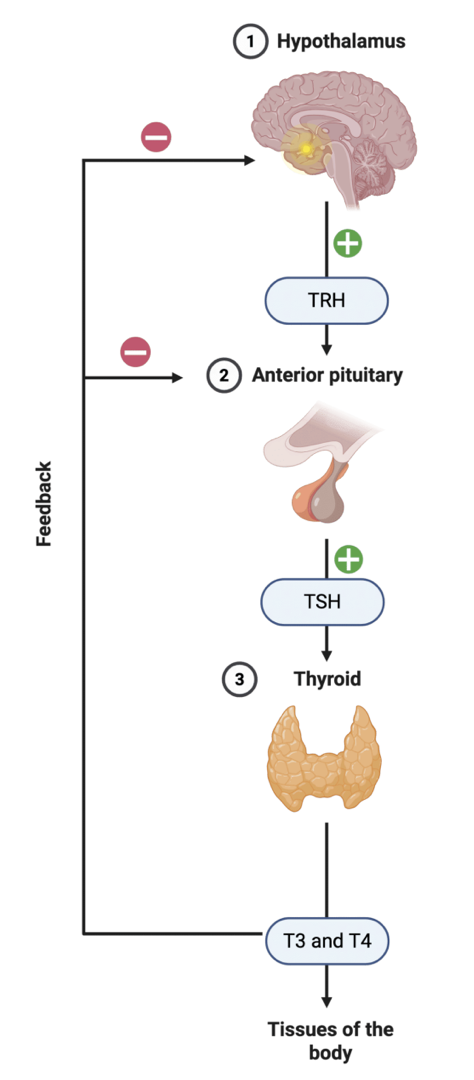
Let’s take a quick trip back to your pathophysiology course. At one point, you likely learned about the negative feedback loop of the hypothalamic-pituitary-thyroid axis (also known as the HPT axis). Remember this picture? (Image)
Long story short, it all starts with the hypothalamus in the brain that releases Thyrotropin-Releasing Hormone (TRH). This TRH travels down to the anterior pituitary and stimulates the release of Thyroid-Stimulating Hormone (TSH). TSH travels down to the thyroid gland and stimulates the thyroid to release T3 and T4 hormones, which is our end goal. These thyroid hormones then travel throughout our body and regulate multiple organs including:
Heart: controls heart rate and inotropy
Metabolism: enhances caloric metabolism
Body Temperature: regulates body temperature by generating heat
Brain: supports concentration, mood, and normal brain function
Muscles: maintains muscle strength and energy
Digestive system: keeps your intestines moving normally
In simple terms, too much or too little thyroid hormone = bad.
Too little thyroid hormone (hypothyroidism) can result in fatigue, weight gain, bradycardia, hypotension, constipation, and feeling cold (practically the clinical presentation that our patient presented with).
Too much thyroid hormone (hyperthyroidism) can result in anxiousness/restlessness, weight loss, tachycardia, hypertension, diarrhea, and hyperthermia.
To differentiate between the two, we look at the free T4. If free T4 is low, then our patient has hypothyroidism. If free T4 is high, then our patient has hyperthyroidism. The next step is determining if it’s primary, secondary or tertiary.
Looking at the HPT axis, thyroid disorders can occur when any of those three organs are damaged since it’s practically a domino effect. If my hypothalamus is damaged, then it won’t release TRH which won’t activate the pituitary gland to release TSH, leading to reduction of T3 and T4. See what I mean about a domino effect?
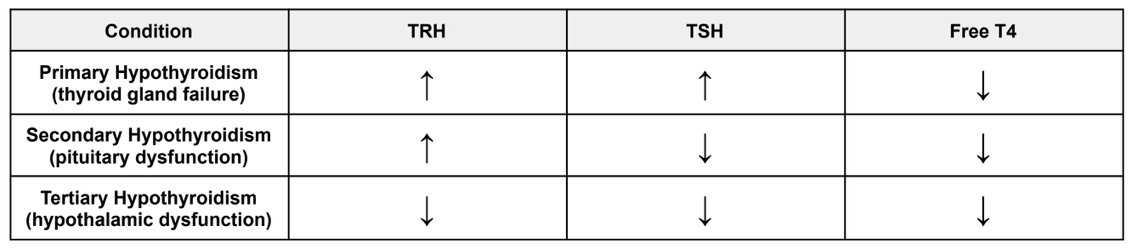
To differentiate where the damage is, we look at the thyroid panel to see where our TRH, TSH, and Free T4 levels are at. Depending on that information, we can diagnose it as primary (thyroid organ damage), secondary (pituitary organ damage), or tertiary (hypothalamic organ damage). That being said, the vast majority of thyroid disorders are primary, meaning they’re due to thyroid damage.
P.S. TRH levels are NOT commonly collected in practice since the only way to get a real level is to break into the brain and measure the level. And that’s just not realistic for most patients. But for completeness sake, we’ll review it all.
So now back to our patient case. Our first step is to look at her free T4 level, which is low. So right off the bat, we know this patient has hypothyroidism. The next step is to look at the other values to see where we stand. Her TSH is elevated meaning that the hypothalamus and pituitary gland are functioning normal. In fact, the TSH level is high because of the negative feedback system.
Because this patient has low free T4, her HPT axis is freaking out and releasing more TRH and TSH to stimulate the thyroid to release more free T4. However, because this patient has primary hypothyroidism, the thyroid gland is damaged and unable to release more free T4 despite getting more TRH and TSH. And in case that was confusing, here is a table that sums it all up.
Does it make sense now? Great, moving on.
Questions #2 & 4: Levothyroxine Dosing
Now that we know our patient has primary hypothyroidism, it’s time to treat. You have 3 main options:
Levothyroxine: composed of T4 hormone
Liothyronine: composed of T3 hormone
Liotrix: combination of T4 and T3
So what the heck is the difference? T4 is inactive, while T3 is the active form of thyroid hormone. T3 binds to receptors quicker, has a stronger therapeutic effect, and is much more toxic. On the other hand, T4 is the “storage” form. It circulates in the bloodstream and is converted into T3 as the body needs it. Therefore, it has a much longer half-life and a lot less toxicity since it’s only activated when actually needed. Because of that, T4 is the recommended treatment of choice for hypothyroidism. Okay, so levothyroxine.
Now it’s time to figure out how much to give. Initial dosing is as follows:
Patients ≤60 years of age without evidence of coronary heart disease: 1.6 mcg/kg/day
Patients >60 years of age without evidence of coronary heart disease: 25 to 50 mcg once daily
Patients with coronary heart disease: 12.5 to 50 mcg once daily
P.S. Lower initial doses are recommended for older patients or those with coronary heart disease because high doses of levothyroxine can trigger angina, precipitate myocardial infarction, cause tachyarrhythmias, and worsen heart failure.
P.P.S. There’s a long debated question about which weight to use when dosing levothyroxine. Because of course a person doesn’t just weigh what they weigh. Life would be too easy that way. (Read the sarcasm there.)
The manufacturer label doesn't necessarily specify which weight to use when dosing the initial levothyroxine dose. Historically, it's been actual body weight. However, the American Thyroid Association recently recognized 2 newer studies in which obese patients required lower mcg/kg doses than non-obese patients, and one of these suggested ideal body weight as a way to account for this.
So while it’s still a gray area, current practice is to use a patient’s actual body weight when dosing levothyroxine UNLESS they’re obese. In that case, use their ideal body weight to avoid overdosing the hormone replacement.
Looking back to our case. Our patient is 34 years old, not obese, and with no evidence of coronary heart disease. So the recommended initial dose for her is 1.6 mcg/kg/day. She weighs 85.7 kg. So simple plug and chug gives us an initial daily dose of 137 mcg daily (answer to question #2).
Now moving on to question #4. Our patient is now pregnant. Does that change anything? Absolutely.
Pregnancy increases the body’s requirement for thyroid hormone. Most women with pre-existing hypothyroidism generally need a 20-30% increase in their levothyroxine dose as soon as pregnancy is confirmed.
This is a common clinical pearl that you will likely get tested on sometime in your career. Since our patient has been on 137 mcg once daily, an increase of ~25% would be appropriate, making answer D the correct choice.
Questions #5 & 6: Levothyroxine Clinical Pearls
Levothyroxine tablet colors. Personally, I hate that this is something you have to remember. It’s a waste of brain space especially since it takes 3 seconds to look it up. I’ve been practicing as a clinical pharmacist for over 6 years, and I have yet to be asked about a levothyroxine tablet color. But the NAPLEX doesn’t always portray the real world. So put it to memory for now, and after the test you can wipe it away. To make it easier, here is a mnemonic to help you remember.
“Orangutans Will Vomit On You Right Before They Become Large Proud Giants”
Orangutans = Orange (25 mcg)
Will = White (50 mcg)
Vomit = Violet (75 mcg)
On = Olive (88 mcg)
You = Yellow (100 mcg)
Right = Red/Rose (112 mcg)
Before = Brown (125 mcg)
They = Turquoise (137 mcg)
Become = Blue (150 mcg)
Large = Lilac (175 mcg)
Proud = Pink (200 mcg)
Giants = Green (300 mcg)
Okay on to question #6: levothyroxine counseling. When it comes to patient education, please remember the following counseling points:
Take it on an empty stomach, ideally 30-60 minutes before breakfast with a full glass of water. Why? Because food, drinks, and supplements can significantly reduce the body’s ability to absorb the medication.
Separate levothyroxine from the following supplements by at least 4 hours:
Calcium supplements
Iron supplements
Aluminum or magnesium-containing antacids
Sucralfate
Cholestyramine/colestipol
Sevelamer
If you miss a dose, take it as soon as you remember that day. If you don’t remember until the next day, take your normal scheduled dose. Do NOT routinely double doses unless specifically instructed by your provider.
It may take 4-6 weeks before you notice the full benefit, and your provider will likely recheck your thyroid panel around that time.
Watch for signs of too much thyroid hormone:
Fast or pounding heartbeat, tremor, nervousness or anxiety, trouble sleeping, excessive sweating, unexplained weight loss
Consistency in the brand or manufacturer is important. If your pharmacy changes manufacturers or you switch between brand and generic, let your healthcare provider know because repeat thyroid testing may be needed.
Notify your provider as soon as you become pregnant. Most patients require approximately 20-30% increase in their levothyroxine dose early in pregnancy.
Question #3: Thyrotoxic Medications
There are several medications that can cause thyroid toxicity by either making the thyroid overactive, damaging the gland, or providing excess thyroid hormone. The big ones that you need to look out for include:
Amiodarone (the most common one)
Amiodarone has very high iodine content which can lead to direct thyroid toxicity. Surprisingly, it can cause both hyperthyroidism and hypothyroidism.
Lithium
Generally causes hypothyroidism but can occasionally cause thyroiditis and transient thyrotoxicosis
Interferon-alpha
Can trigger autoimmune thyroid disease or thyroiditis, leading to hyperthyroidism or hypothyroidism
Immune checkpoint inhibitors (e.g., pembrolizumab, nivolumab, ipilimumab)
Immune activation may cause destructive thyroiditis with an initial hyperthyroid phase followed by hypothyroidism.
Iodinated contrast media
Large iodine load may trigger hyperthyroidism especially in patients with nodular thyroid disease or latent Graves’.
Well folks, that sums up our case. Hopefully you learned something new today and are ready to tackle the world of thyroid disorders.
And again, if there is another topic that you want us to write a case about please shoot me an email at josef@tldpharmacy.com.