
The tl;dr Case of the Month: Pulmonary Embolism
A note from the tl;dr team: we are so back with another case of the month. In case you missed the other ones we've posted, I'll link them below:
Just like always, the answers and explanations of the case will follow. So just keep on scrolling, and you'll get there :)
P.S. If there is a specific topic that you would like us to cover in a future case, feel free to reach out to me at josef@tldrpharmacy.com.
Meet Your Patient
Patient: ST
Age: 32 years
Sex: Female
Weight: 70.9 kg
Vitals: BP (128/86 mmHg), HR (98 bpm), RR (17 breaths/min), Temp (98.1 F), O2 Saturation (96%)

The patient’s husband after hearing the CTPA results.
Subjective: ST is a 32-year-old female who presents to your emergency department complaining of shortness of breath and pleuritic chest pain that worsens with deep inspiration or cough. She states that symptoms have persisted for 48 hours but didn't think it was severe enough to warrant an ED visit. However, her husband did not feel comfortable and convinced her to come into the ED for a check-up. (Image)
Objective
Past Medical History: GERD, Vitamin D deficiency, Depression, G3P2012, 10 weeks postpartum and currently breastfeeding
Home Medications: escitalopram 40 mg PO once daily, pantoprazole 40 mg PO once daily, cholecalciferol 600 IU PO daily, acetaminophen 650 mg PO Q6H PRN pain, melatonin 3 mg PO HS PRN sleep, Junel Fe 1/20 1 tablet PO daily, epinephrine pen 0.3 mg IM once PRN anaphylaxis
Allergies: penicillin (hives), bees (anaphylaxis)
Assessment:
CBC: within normal limits
CMP: Serum creatinine 0.92 mg/dL; all other levels within normal limits
Imaging: CTPA of the chest positive for acute pulmonary embolism involving the right lower lobe segmental pulmonary arteries, without evidence of right ventricular strain
ECG: normal sinus with stable QTc
1) Based on the clinical presentation, vital signs, and diagnostic findings, which of the following categories best classifies her pulmonary embolism according to the 2026 AHA/ACC Acute Pulmonary Embolism Guideline?
a) Category A
b) Category B
c) Category C
d) Category D
e) Category E
2) Which of the following treatment regimens is the most appropriate to start for this patient?
a) Warfarin 10 mg PO once daily
b) Apixaban 10 mg PO BID for 7 days, followed by 5 mg PO BID thereafter
c) Rivaroxaban 20 mg PO once daily in the evening
d) IV Unfractionated Heparin 5700 units once, followed by 1270 units/hour thereafter
e) Enoxaparin 70 mg SC twice daily
3) Which of the patient's home medications is associated with an increased risk for venous thromboembolism?
a) Escitalopram
b) Cholecalciferol
c) Epinephrine
d) Junel Fe 1/20
e) Melatonin
4) Based on the patient's clinical presentation and identified risk factors, which of the following is the most appropriate duration of therapeutic anticoagulation for her acute pulmonary embolism?
a) at least 1 month
b) at least 3 months
c) at least 6 months
d) at least 12 months
e) Indefinitely
5) Which of the following counseling point(s) is/are most appropriate when initiating therapeutic anticoagulation? (select all that apply)
a) Avoid all physical activity throughout treatment
b) Stop breastfeeding while on therapeutic anticoagulation
c) Avoid NSAIDs when possible and continue to use acetaminophen for over-the-counter pain relief
d) Seek immediate medical attention if you experience black, tarry stools or blood in the urine
e) Seek immediate medication attention if you experience any head trauma, even without obvious bleeding
Alright, ready for the answers? Take a peek below:
1. B
2. E
3. D
4. B
5. C,D, & E
Need More Venous Thromboembolism & Anticoagulation Review?
Here at tl;dr pharmacy, we like to have our bases covered. While this patient case gives a good review of PE, it is not an all-inclusive guide to thromboembolism or anticoagulation. If you are looking for a more in-depth review of these topics, check out some of our products linked below:
Review of Pulmonary Embolism (and yes, it does include the updates from the 2026 AHA/ACC guidelines)
Review of venous thromboembolism prophylaxis in hospitalized medical patients
Our pocket guides which include DVT, PE, anticoagulation and much more!
Oh and one more thing. If you like the style of these cases and want more questions just like this, check out our NAPLEX practice exam. Okay, I digress. Let's dive into the answers for our case :)
Question #1: Pulmonary Embolism Categories
Yes, these categories are brand new. Earlier this year, the AHA/ACC updated their pulmonary embolism guideline and completely revamped the pulmonary embolism classifications. So long are the days of categorizing PEs as low-risk, sub-massive, and massive.
Instead, this guideline replaced the traditional terminology with a 5-category system. These include:
Category A: subclinical/incidental, asymptomatic PE --> safe for ED discharge
Category B: symptomatic, low clinical severity --> early discharge/outpatient treatment
Category C: symptomatic, elevated severity score --> hospitalize
Category D: incipient cardiopulmonary failure (normotensive shock, transient hypotension) --> hospitalize, consider advanced therapies
Category E: cardiopulmonary failure with persistent hypotension/cardiogenic shock or cardiac arrest --> hospitalize, advanced therapies reasonable
Now let's apply this to our patient case. She is symptomatic so that automatically rules out category A. She is clinically stable given her hemodynamics with no evidence of right ventricular heart strain so that rules out categories D and E. That leaves us with categories B and C. The main difference between these two categories is the severity score. How do we assess that? Great question!
The simplified Pulmonary Embolism Severity Index (sPESI) is used to estimate 30-day mortality risk following an acute PE. Scoring is as follows:
Age >80 years - 1 point
History of cancer - 1 point
Chronic cardiopulmonary disease - 1 point
HR ≥110 bpm - 1 point
SBP <100 mmHg - 1 point
SpO2 <90% - 1 point
The patient in our case scored a total of 0 points and therefore belongs to category B.
Question #2: PE Treatment
The updated 2026 AHA/ACC PE guideline did update treatment as well. Here are the new changes:
DOACs are recommended over warfarin. Why? Because studies showed comparable efficacy but lower rates of major bleeding, including intracranial hemorrhage. That doesn't mean warfarin should never be used (more on that later). But if possible, DOACs are preferred as long as there is no contraindication to DOAC use.
LMWH (e.g., enoxaparin) is recommended over unfractionated heparin when initial parenteral therapy is needed. Why? Because LMWH has shown reduced risk for recurrent VTE, lower risk for HIT, and has predictable pharmacokinetics.
For a patient presenting with a category B PE, a DOAC such as apixaban or rivaroxaban is going to be the recommended agent the majority of the time. However, that's not always the case. As you may have noticed, our patient is 10 weeks postpartum and currently breastfeeding. DOACs may cross into breastmilk and are therefore NOT recommended for use in breastfeeding patients.
The updated PE guideline recommends the use of LMWH, UFH, or warfarin over DOACs for the treatment of PE in breastfeeding patients. Since this patient is category B, outpatient therapy is recommended and use of UFH IV drip is not appropriate. Warfarin could be used for this patient, but a starting dose of 10 mg daily is also not appropriate. That leaves us with enoxaparin 1 mg/kg BID, making answer E the correct answer.
While I have you here though, let's quickly review the rest of the guideline treatment recommendations in special populations.
Obesity: DOACs are reasonable over warfarin
CKD Stage 2-3: DOACs are recommended over warfarin to reduce major bleeding
CKD Stage 4-5/ESRD on dialysis: uncertain whether apixaban is better than warfarin
Antiphospholipid syndrome: warfarin recommended over DOACs
Pregnancy: LMWH or UFH recommended. DOACs and warfarin are NOT recommended given risk for fetal anomalies and miscarriage.
Breastfeeding: LMWH, UFH, or warfarin recommended over DOACs since DOACs may cross into breastmilk
Chronic liver disease: DOACs are reasonable over warfarin in Child-Pugh A and B. However, DOACs are NOT recommended in Child-Pugh C.
Cancer-Associated PE: DOAC or LMWH is recommended over warfarin for extended therapy
Brain Tumors: DOACs may be considered over LMWH to reduce ICH risk
Got it? Great! Onto the next question!
Question #3: Commonly Prescribed Medications That Can Increase the Risk for Venous Thromboembolism
Every medication we dispense comes with risk and benefits. Ultimately, we always aim to initiate meds that provide more benefit than harm. But these adverse reactions can’t always be avoided. And one of those risks is thrombosis. While the risk is usually minimal in most patients, it can still occur. And that’s why it’s important for us to recognize which medications can cause this to help facilitate discontinuation. There’s really no good way to remember some of these common agents other than to memorize them. So here is a big list of the commonly prescribed meds that can increase the risk for thrombosis.
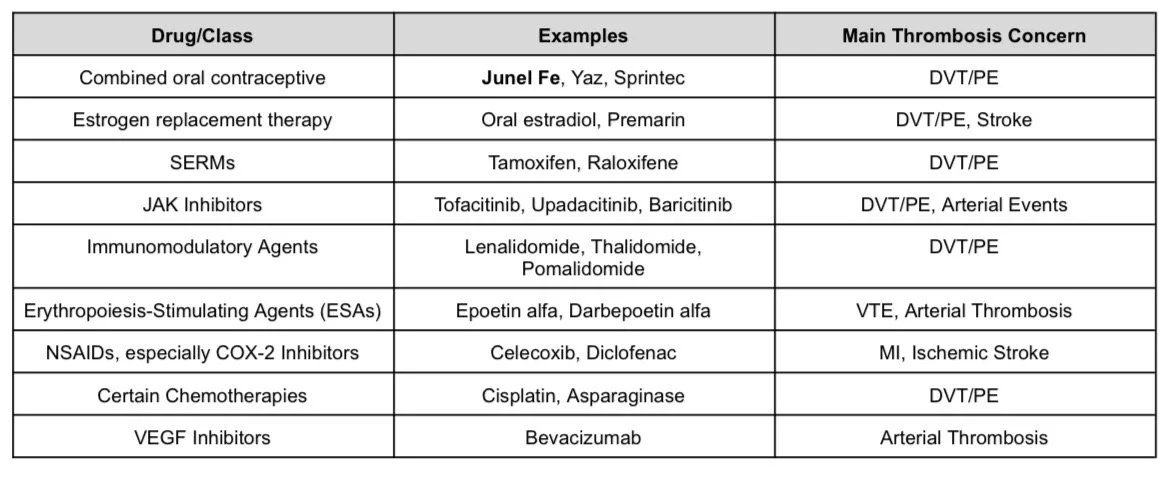
Yes, I bolded Junel Fe for a reason. Because that’s the answer for our patient case. Out of all her current medications, only Junel Fe carries a risk for venous thromboembolism and is likely the cause of her PE.
Question #4: Duration of Treatment

Bob worked in the gray areas too, although he could pull off “happy accidents” more easily than we pharmacists can!
If we’re being honest, the duration of treatment of PE isn’t super straight forward. A lot of it is a grey area in which we depend on provider preference and patient specific factors. (Image) That being said, there is some guidance to help us clinicians decide.
For starters, the absolute bare minimum treatment duration of a PE is at least 3 months. So that automatically gets rid of the at least 1 month answer. And there is no routine recommendation to treat an uncomplicated PE for exactly 12 months either, so we can get rid of that answer. That leaves us with at least 3 months, 6 months, and indefinitely.
3 months: this is generally sufficient for a first PE provoked by a clearly reversible factor. In our case, we have a pretty healthy young female with no comorbid conditions or risk factors for thrombosis. We can confidently presume that this is a provoked PE caused by her Junel Fe prescription. When this combined oral contraceptive is stopped, she has no other substantial risk factors remaining.
Therefore, at least 3 months of anticoagulation therapy with a reassessment is the best answer for this case.
6 months: at least six months of therapy is generally recommended for active cancer-associated PE or a PE with a persistent provoking risk factor. Our patient has neither of these, and therefore this answer is not correct.
Indefinitely: when we say indefinitely we don’t actually mean forever and that therapy can never stop. The risks and benefits for clotting versus bleeding should be reassessed periodically. But in general, patients on indefinite anticoagulation for a PE are those with recurrent unprovoked PEs and those who have major ongoing risk factors for PE, such as antiphospholipid syndrome. Our patient does not belong in this category, thus making this answer incorrect.
Question #5: Anticoagulation Patient Education
Blood thinners are a high-risk medication class. Patient education is so vital to avoid unnecessary life-threatening bleeds. To make your life easier, here is a big list of common patient education points that you should discuss with your patient before they start anticoagulation therapy.
Medication Adherence:
Take your blood thinner exactly as prescribed
Do not skip doses or discontinue treatment without discussing it with your healthcare provider
Blood thinners prevent clot extension and new clot formation while the body gradually breaks down the existing clot
If you miss a dose, follow the specific instructions for your blood thinner, Do not automatically double the next dose
Continue treatment for the entire prescribed duration even if your symptoms resolve
Bleeding Precautions:
Minor bruising and small cuts that bleed longer than usual may occur
Use a soft-bristled toothbrush and an electric razor
Avoid contact sports and activities associated with significant injury
Apply firm, continuous pressure to minor cuts until the bleeding stops
Notify your healthcare provider if you experience unusually heavy menstrual bleeding, frequent nosebleeds, or excessive bruising
Seek Immediate Medical Attention For:
Vomiting blood or material resembling coffee grounds
Black, tarry stools or blood in the urine
Severe persistent headache, confusion, or neurological changes
Bleeding that does not stop with direct pressure
Any significant injury, even without obvious bleeding
Drug Interactions:
Avoid NSAIDs such as ibuprofen, naproxen, and aspirin unless specifically prescribed
Acetaminophen is generally preferred for pain and is safe to take with blood thinners
Consult your pharmacist before starting new prescription medications, OTC medications, or supplements
Certain antibiotics, antifungals, and herbal products can increase bleeding risk or alter blood thinner effectiveness
Lifestyle Modifications:
Avoid prolonged immobility; take regular walking breaks during extended travel
Maintain adequate hydration
Avoid smoking
Maintain physical activity as tolerated, gradually increasing activity after pulmonary embolism
Inform all healthcare providers, including dentists, that you take a blood thinner
Consider carrying a medical alert card identifying your blood thinner
Well folks, that’s all she wrote. I hope you enjoyed this case and now feel like a PE expert. Again, if there is a specific topic that you would like us to cover in a future case, feel free to reach out to me at josef@tldrpharmacy.com.