
The Pharmacist's Quick Rundown on Asthma Updates
Steph’s Note: I know we’ve already had the tl;dr Case of the Month for November, but we’re just loving this case-based format so much that I couldn’t resist adding another one. ICYMI, here are the links to the other cases, covering a wide variety of topics:
Happy learning!
Meet Your Patient
Patient: HM
Age: 37 years
Sex: Female
Weight: 93 kg
Vitals: BP 135/84 mmHg, HR 93 bpm, RR 25 breaths/min, Temp 98.3F, SpO2 92%
Subjective: HM is a 37 year old female who presents to your clinic from home complaining of severe shortness of breath, wheezing, chest tightness, and “feeling like a fish out of water.” She’s been waking up at 4-5 am every night coughing and having a hard time getting a breath. The difficulty breathing gets worse with any exercise, including walking and pushing her baby’s stroller. She has used a family member’s leftover albuterol inhaler about 10 times in the last 2 days and around twice a day before that. Her symptoms started about a month ago when the weather turned cooler, but they worsened the last couple of days when she also started with a runny nose and sinus congestion. The only time she’s felt like this previously was after a cold in 9th grade when she couldn’t breathe during basketball practice.
Objective
Past Medical History: Gestational diabetes, obesity, GERD
Home Medications: Prenatal vitamin 1 tablet PO daily, vitamin D 2000 IU PO daily, albuterol MDI 2 puffs inhaled q4-6 hours PRN
Allergies: NKA
Assessment
CBC: Within normal limits except eosinophils 1230 cells/uL (range 40-360 cells/uL)
CMP: WNL
1. Which of the patient’s symptoms is/are characteristic of asthma? (Mark all that apply.)
a. Shortness of breath
b. Wheezing
c. Cough, especially at night
d. Chest tightness
e. Worsening symptoms upon exertion
2. Which of the following asthma triggers could have contributed to this patient’s current symptoms? (Check all that apply.)
a. Prenatal vitamin
b. Pregnancy
c. Viral upper respiratory tract infection
d. Seasonal allergies
e. GERD
3. How would you classify this patient’s asthma control?
a. Well-controlled
b. Partly-controlled
c. Uncontrolled
4. The physician has ruled out other causes of her shortness of breath and believes her symptoms are due to asthma. She would like to start the patient on therapy. Which medication regimen is preferred for this patient’s asthma?
a. Albuterol MDI 2 puffs inhaled q4-6 hours PRN
b. Prednisone 40 mg PO daily x 5 days PLUS Budesonide-formoterol 160 mcg/4.5 mcg 2 puffs inhaled BID PLUS 1 puff PRN
c. Fluticasone 44 mcg HFA MDI 1 puff inhaled BID plus albuterol MDI 2 puffs q4-6 hours PRN
d. Budesonide-formoterol 160 mcg/4.5 mcg 1 puff inhaled PRN (no more than 12 inhalations/24 hours)
e. Prednisone 40 mg PO daily indefinitely
5. The patient starts her recommended therapy and achieves better symptom control. At what point after achieving control should she be considered for stepping down treatment intensity?
a. After 2 weeks
b. After 2-3 months
c. After 6 months
d. After 1 year
e. Never (aka she will remain on her current therapy indefinitely)
Ok, ready for the answers? Here you go!
1. A, B, C, D, E
2. B, C, D, E
3. C
4. B
5. B
Want More Practice?
If you liked the format of our case series and want some more questions to test yourself, then check out our NAPLEX practice exam. This exam is the real deal. It has a total of 225 questions and is timed for 6 hours, just like the real exam. It’s as real as it gets, folks. And if you don’t score as high as you wanted and need some tutoring then sign up for an hour session through our private 1-on-1 NAPLEX tutoring. We really like to have our bases covered here at tl;dr pharmacy.
Review Time
Let’s start with some definitions and numbers. Asthma is a chronic airway disease caused by chronic inflammation. In the US, it affects nearly 28 million people (~1 in 12) and leads to approximately 1 million emergency department visits annually. Believe it or not, between 9 to 11 people die from asthma every day in the US. Not some third world country (those numbers are worse) - here in the US.
Asthma is characterized by fluctuating symptoms. People may have times of worsening symptoms followed by improvement or even normalcy, and symptoms may be frequent or infrequent. Symptoms may be mild, or they can be severe - and people can and do still pass away from asthma. The physiologic issue in asthma is restricted expiratory air flow caused by narrowed airways (bronchoconstriction), thicker airway walls, and increased mucus (Image).
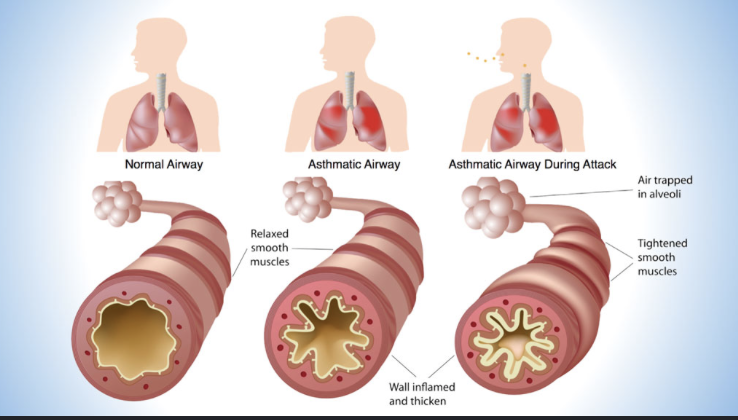
It quite literally becomes difficult to catch a breath, which is where the feeling of being a “fish out of water” comes from.
Now that we have this part down, let’s take a look at the questions.
Question #1: Symptoms of Asthma
Asthma symptoms are the result of the aforementioned restricted expiratory air flow. Hallmark complaints are wheezing (especially when breathing out), shortness of breath, chest tightness, and cough. These symptoms often vary in frequency and intensity. Cough often worsens at night, and people may either wake up due to coughing OR may begin coughing shortly after awakening. Exercise typically worsens symptoms, along with laughing, cold air, and encountering allergens. So all of the answers listed here are characteristic of asthma.
Now, obviously we pharmacists aren’t diagnosticians, but we should still have our thinking caps on. Many of these symptoms are relatively nonspecific and overlap with other conditions. We should still be considering whether there is an alternative or additional cause for the patient’s symptoms. She was recently pregnant - does she have a pulmonary embolism? She’s obese - could it be some form of heart failure, or is her exercise tolerance reduced in the postpartum period? She said she was sick - could she have a brewing pneumonia? Is she taking any medications that could be contributing to her cough and other symptoms (e.g., ACE inhibitors)? Does she have chronic sinusitis that could be causing her cough?
So don’t forget to keep your differential brain turned on even though the physical exam by the provider will often be revealing for ruling these other potentials in or out. Spirometry is rarely available in the clinic, especially for first time visits, so we can’t really rely on having an objective bronchodilator responsiveness test. That being said, our patient does have an elevated blood eosinophil count, which can support the diagnosis of asthma (but can also be due to variations throughout the day or other non-asthma conditions). A normal blood eosinophil count does NOT rule out asthma.
Question #2: Asthma Triggers
Triggers are conditions or objects that cause asthma or make asthma symptoms worse. The better a patient’s asthma is controlled by treatment, the less likely a trigger is to cause an asthma attack.
In our patient, her potential triggers include her recent pregnancy, her viral respiratory infection, her likely seasonal allergies, and potentially her GERD. Although some medications can cause symptoms of asthma (e.g., non-selective beta blockers, aspirin), prenatal vitamins would not be high on the suspicious list.
Pregnancy is an odd one. One pulmonologist once told me the “rule” is a 1/3, a 1/3, a 1/3. According to him, a third of pregnant patients will experience better asthma symptoms than before, a third will stay the same during pregnancy, and a third will worsen. So it’s basically a toss up which way pregnancy will influence asthma, and it’s possible that this patient’s pregnancy triggered worsening asthma symptoms (even though she’s no longer pregnant, it may have set off a cascade).
Viral upper respiratory infections can trigger onset of asthma or worsen existing symptoms. People with asthma should be sure to receive all age-appropriate vaccinations (e.g., flu, RSV, pneumococcus, pertussis, COVID) to alleviate viral symptom severity and reduce the risk of triggering asthma.

The patient said her symptoms started when the weather changed, which could indicate a seasonal component to her triggers. Pollen levels of an allergen may have increased with the weather change. She may have previously undiagnosed and untreated seasonal allergies that are causing rhinosinusitis and cough that are layering on top of asthma as well (Image).
Untreated/uncontrolled gastroesophageal reflux disease (GERD) can also be a risk factor for exacerbating asthma symptoms. Asymptomatic GERD is unlikely to contribute to asthma though, so treatment with anti reflux medications should really only be for those who have symptoms of GERD.
The patient is also noted to be obese, which is a potential risk factor for worsening asthma symptoms. Weight reduction should be part of our patient’s treatment plan as even a 5-10% decrease can improve asthma control.
Question #3: Asthma Control Classifications
Being able to classify how well controlled a patient’s asthma is is important since it sets the stage for choosing pharmacotherapy. Check out the graphic below for determining asthma symptom control (Image):
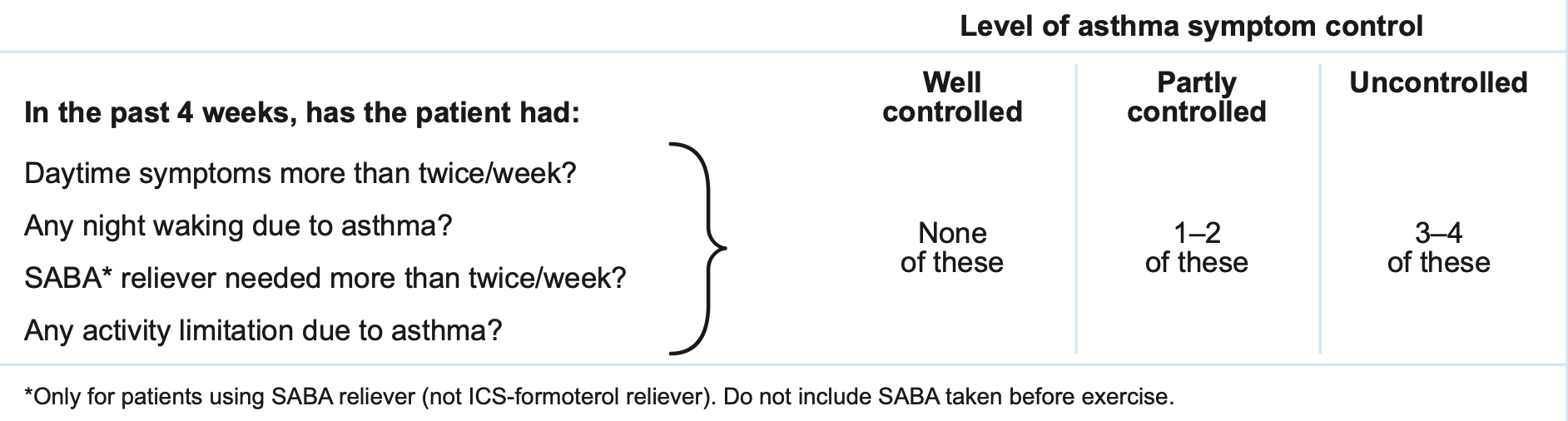
Our patient has described pretty persistent symptoms even while just walking, so she’s definitely having daytime symptoms more than twice/week. She’s waking up pretty much every night coughing. She’s used albuterol 10 times in the past 2 days (likely contributing to her elevated heart rate…). And she’s having a hard time pushing her baby’s stroller, so yes for activity limitations. So she meets all 4 of the criteria for being uncontrolled.
Question #4: Pharmacotherapy for Asthma
With the release of the 2026 Global Initiative for Asthma (GINA) guidelines, there have been some pretty significant updates to the treatment of asthma. Here are some of the major pearls before we get into therapy choices:
Using albuterol alone as a rescue inhaler is no longer recommended. In fact, it is associated with an increased risk of exacerbations, worse lung function, and increased risk of death due to asthma! It increases airway inflammation and reduces responsiveness to SABA rescue treatment.
Every patient should have an inhaled corticosteroid (ICS) in some form or fashion, whether alone or in combination with another medication. ICS reduces the risk of asthma hospitalizations and death. They also improve lung function.
Every patient needs a rapid-acting rescue inhaler with low dose ICS-formoterol being the preferred option.
The GINA guidelines provide for 2 tracks of treatment with Track 1 preferred due to simplicity and evidence of reduced exacerbations. In the name of keeping things simple, here’s GINA Track 1 for initial treatment choices:
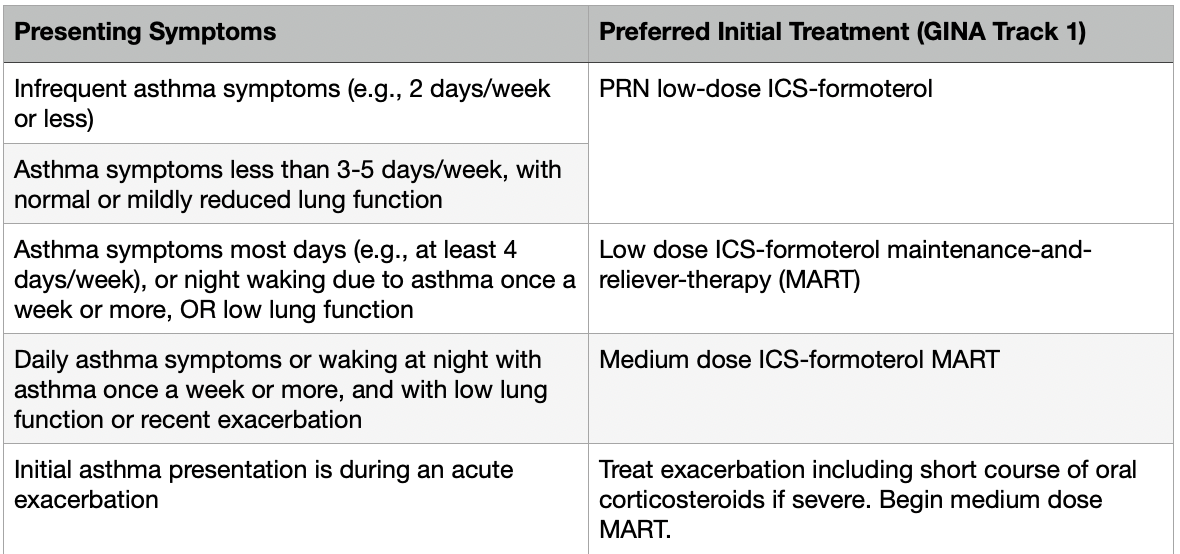
Our patient meets criteria for presenting during an acute exacerbation as she has been experiencing worsening asthma symptoms over the past few days despite increasing use of a rescue inhaler. She is also in the middle of a viral upper respiratory tract infection, which would also point to triggering an exacerbation. Given the severity of her symptoms both daytime and nighttime and her limitations in activity, she would qualify for a short course of oral corticosteroids, typically prednisone 40 mg PO daily x 5-7 days. There is no need to taper given the course is less than 2 weeks long.
Additionally, according to the chart, she should begin medium dose MART, which means using one inhaler for both her maintenance and her reliever medication. In her case, budesonide-formoterol 160 mcg/4.5 mcg 2 puffs BID equals 640 mcg of budesonide/day, which falls in the medium dose range of >400-800 mcg/day. Plus, she can use 1 puff of that same medication as needed for her reliever if she needs it; however, if she requires more than 12 total inhalations of her budesonide-formoterol in a 24 hour period, she needs to seek medical advice.
Answer choice A is incorrect because solo albuterol is now persona non grata. See above for the reasons.
Answer choice C is incorrect because (first) it doesn’t treat the exacerbation. Second, it is low dose ICS therapy, but this patient qualifies for medium dose MART as she is presenting during an exacerbation. Third, it uses albuterol as the rescue, which is from the non-preferred GINA Track 2.
Answer choice D is incorrect because it does not provide any maintenance therapy, only a PRN reliever. Because this patient presented in an exacerbation, she qualifies for medium dose MART.
Answer choice E is incorrect because…ew… indefinite oral corticosteroids! Not necessary in this initial case! Think of the adverse effects, oh my!
See the GINA guidelines for a full chart of what is considered low, medium, or high dose ICS therapy for various medications.
Question #5: Stepping Down Therapy
Once patients are initiated on pharmacotherapy for their asthma, will they always have to take that therapy? Forever and ever and ever?
Not necessarily.
After an exacerbation, patients should be monitored regularly to ensure they are doing better, using their inhalers correctly, getting an ICS-containing medication, and have an asthma action plan in place for what to do if/when symptoms worsen. Discussions about how to potentially reduce any triggers, including any vaccination catch up, should take place as well. Patients should be asked about albuterol use to ensure that regular use or overuse isn’t contributing to exacerbations.
Once adequate symptom control has been achieved (see that chart above about “well-controlled”) for 2-3 months, patients can consider stepping down therapy.
Final Thoughts
You may have noticed that we didn’t talk about inhaler technique in this asthma post. And you may be thinking, gosh, tl;dr has lost its touch. BUT there’s a reason for this… EVERY INHALER IS DIFFERENT. Which is why it’s so important for you, the pharmacist, to assess which inhaler is prescribed and ensure the patient knows how to use that specific product. For example, (the now apparently blacklisted) albuterol MDI requires shaking and priming; however, the Qvar Redihaler (beclomethasone HFA) I dispensed last week specifically notes NO shaking and NO priming.
Long story short, when counseling patients on their inhalers and checking their inhaler technique, always double check the specific product guidelines!