International Pharmacy: How to Use Your Pharmacist Knowledge for Global Impact
Oh yeah, I’m showing my age now…this was my jam in elementary school computer class. Check out that CD-ROM.
Steph’s Note: This week, I’m psyched. I have the pleasure of introducing you to my friend, Dr. Hannah Morris. Hannah and I worked together at UVA for several years, where we bonded over our mutual love of baking, sports, and the outdoors, and then she went off to make the world a better place whereas I started increasing its population. She is legitimately one of the kindest and best people I know, not to mention one of the coolest, smartest, jet setting pharmacists. (Honestly, when I text her, it’s a bit like Where in the World is Carmen Sandiego?, the service edition.) How did she make the leap from transplant to global pharmacy? How is she using her pharmacy knowledge now? Pull up a chair and settle in because here’s her fascinating story.
Have you ever seen your friends go on a missions trip or work with a humanitarian organization and thought how cool it would be do it too? If yes, this post is for you. Not only can you do international work as a pharmacist, there’s a definite need for pharmacists around the world. And guess what - you don’t have to go back to school or get licensed in a foreign country to do it!
I’m Hannah, a residency-trained clinical pharmacist who transitioned to working in humanitarian aid in 2021. For over 4 years, I worked full-time in humanitarian aid and have completed multiple deployments overseas, both in development health programs and short-term missions/disaster relief. I’m currently working part-time in an institution and part-time with a medical missions agency.
While I am by no means an expert in the field, I have learned a lot and hope the information I share is helpful for anyone who has an interest in international pharmacy work. If you want to know more, I’m always happy to answer questions or connect you to people who can help get you more information. I’ll also happily regale you with stories from my time overseas. For example, waking up to a hoard of baboons surrounding you and barking is quite a start to your 30th birthday!
The first thing people ask me is why I decided to leave a job as a solid organ transplant clinical pharmacist at an academic medical center to live in insecure areas of the world. I am not an adrenaline junky, and I very much enjoy the comfort of home. I had worked into a specialist job I loved, and I enjoyed where I lived. So why did I leave it all behind?
Everyone has a different reason, but for me it was my faith and a passion I’ve had since I was a young child. I grew up in a Christian family and was fascinated by the stories of medical missionaries reaching people all over the world. It was something that stuck with me, and when I decided to pursue healthcare in college, I had in the back of my head that I would at least be active in short-term medical mission work.
When I graduated and began working, I still had the desire to do medical mission work, but I found it nearly impossible to get the time off. Any pharmacist can tell you that vacation requests usually have to be submitted multiple months ahead and that there’s usually heavy competition for specific times of the year.

Over the next 5 years of working, the desire to do medical missions only increased, and I began looking for international healthcare jobs. The amount of times I heard, “We appreciate the interest, but we don’t take pharmacists” were too numerous to count. (Image) So I began looking for opportunities adjacent to healthcare and found a position that sounded amazing…but they were looking for a public health degree in addition to a healthcare degree.
After a lot of prayer, I went back to school and completed a master’s degree in public health with a concentration in global health (yay for down time during CoVID). I was able to do my intern hours in El Salvador with a medical missions organization, and while standing on the hostel balcony in a remote town in the mountains of El Salvador, I received a call offering me a post-graduate fellowship with an international disaster relief organization. That was Easter of 2021. I resigned my position at the hospital, packed all my possessions into my parent’s garage, and started my international humanitarian career on June 1st.
I recognize my story is a bit of an oddity. Not many people have the ability to leave a full-time job that provides income, health insurance, and a retirement plan to work with international people who have limited or no access to healthcare. But if international work sparks your interest, I hope this post gives you some information to help you on your way to reaching people all over the world with your skills and knowledge.
Pharmacy in the International Short-Term/Disaster Relief Setting
Short-term relief is one of the most common ways people get involved in international work because let’s be honest, most people don’t have the ability to move to another country on a permanent basis. Short-term relief can range from weeklong medical mission trips to month long disaster relief deployments. You can even do missions in the United States! For the sake of this post, we’re going to focus on international work, but domestic service is definitely an option.
Disaster Relief
There are so many options to get connected to short-term relief work. Humanitarian organizations (aka non-governmental organizations or NGOs) often have disaster relief rosters that are in need of medical professionals, including pharmacists. You can generally find postings for these positions on the career or volunteer pages for NGOs that do relief work. These include organizations such as MEDAIR, Project Hope, International Medical Corps, Americares, etc. Some of these organizations may provide compensation or cover the costs for the trip if you deploy in an emergency response. You’ll go through either a volunteer or job application process to get on the emergency response roster, and then if approved, you usually go to onsite training.
Every organization provides different types of services in disaster relief, so the type of pharmacy you may be doing could vary from an emergency field hospital (EFH) with a full pharmacy to mobile medical clinics with small backpacks of medicine. If you’re working in an EFH, there are tiers to the level of services that are provided:
outpatient and urgent care only,
basic inpatient services,
operating rooms with inpatient services, and
intensive care.
The level of services provided dictates your formulary, although your access to opioids for pain management will likely be limited. You generally have oral antibiotics from nearly every class and injectable antibiotics for treatment of sexually transmitted infections (STI). There are also chronic disease medications, but these are more limited than you’re used to. For example, you may have an ACEi, selective beta-blocker, and a calcium channel blocker, but it’s unlikely there’s more than one agent or more than one strength. At the higher levels of care, there are refrigerated medicines such as succinylcholine, but because of cold chain challenges, it’s a very limited supply of a very few agents that need to be refrigerated. Regardless, you’ll stretch yourself as a practitioner working in a limited resource setting, especially since you may or may not have access to the internet for drug information resources. (Image)

Unfortunately, this just isn’t true for international service work!
One of the most creative pharmacy challenges I’ve been a part of is making peritoneal dialysis (PD) fluid with IV fluids and 50% dextrose. We were in Turkey running an EFH made of inflatable tents in the week after the 2023 earthquake that hit southern Turkey and northern Syria. Shortly after we got up and running, a second 6+ magnitude earthquake hit, and we received multiple patients that night and in the days following. One was a middle aged lady who had crush injuries and had been turned away from several other hospitals. By the time she arrived at our EFH, she was in renal failure, and without dialysis, it was unlikely she would survive. We were fortunate enough to have a surgeon on staff who had run a dialysis program in a rural part of Africa and had a formula to make PD fluid. You would not believe how well PD worked with the fluid we made! She began improving within a few days of starting PD and was safely discharged with return of renal function not long after.
Then there was the night we ran a mass casualty event, and I was cracking tranexamic acid ampules like a crazy person. We got so busy that I ended up working under the medical director to prescribe pain meds and antibiotics for stable people going to wards so the physicians could focus on the urgent cases in the ER and ICU. In those moments, I knew I was exactly where I was supposed to be and that I brought tremendous value to the team as a pharmacist.
Disaster relief is unlike anything else you can do in pharmacy. Word of warning, it will not be the most comfortable environment. I’ve spent more days sleeping on a canvas bunk cot, eating MREs (Meals, Ready to Eat), and using a bathroom trailer than I can count. Usually you’re living and working in tents or out of hotel rooms converted into offices. If you go on the front end to get things started, resources are sparse while your logistics team gets things set up, such as bathrooms, showers, food, and laundry. Once the logistics are established, life gets a bit more comfortable.
You still may not have hot water, and odds are at least some of your laundry will disappear or end up in someone else’s bag. If you have food allergies you’re definitely going to have to bring your own supply because food allergies are not something that can be accommodated in a disaster type setting. But you’ll never forget the people you work with.
If you’re someone who enjoys disaster relief work, odds are you don’t know many people who share that passion. However, when you go on disaster relief deployments, you’re surrounded by people who love it just as much as you. You find your people, and it’s really special. Plus you’ll have the best stories to share when you get back. For example, one of my friends was stuck in the bathroom trailer during a 6+ magnitude earthquake, and she says the only thing she could think of in the moment was how gross it would be if the trailer tipped over!! You’re there to serve, but you’re also going to make memories and friendships that last for a lifetime.
Medical Missions
For those who do not find the idea of more austere and risky environments appealing, medical mission trips are a great way to serve around the world with a bit more comfort. Usually for a medical missions trip, you’re staying in a hotel or hostel that provides all the basic necessities, such as beds, showers, toilets (type may vary), and a secure space. Your access to comforts such as air conditioning and hot water may or may not be available, but odds are you’ll have more comforts overall.
Usually lunch is provided at the clinic, which will often be a local dish, but you’ll want to be cautious about what you eat. Some basic rules are essential to not end up with a GI issue during the trip:
Don’t drink the local water or brush your teeth with it,
Only eat raw fruits/vegetables if you can peel them, and
All meats should be cooked to well done.
Trust me when I say that you do not want to break those rules. The consequences can be in a word…violent.
You’ll see many interesting cases and refresh your primary care knowledge on a medical mission trip. The population you’re serving really determines what kind of diseases you treat. For example, if you’re working in a low-income community with limited access to clean water, you’re going to likely treat more communicable diseases and dermatologic conditions. In places where people are unable to regularly wash their clothes and their bedding, you’ll find more incidences of scabies, lice, bedbugs, etc. If prostitution or trafficking is common in the community, you’ll also find that you’re treating many cases of STIs and pelvic inflammatory disease (PID). Sometimes you get to see things you’d never come across in the states, such as parasites or things even more exotic.
For example, the bubonic plague is still endemic in Madagascar. Ebola is endemic in subsaharan African countries, such as the Democratic Republic of Congo. And malaria is rampant across much of Africa, South America, and Asia.

Steve Harvey can’t believe it either…yeesh.
One of the craziest moments for me was during a clinic in Madagascar. A small child was being seen by a provider for a suspected GI parasite. The next thing we know, the kid leans over his mom’s arm and vomits up a 6 inch long roundworm! We had been debating whether to give him a long course of albendazole to treat an active tapeworm or a short-course for a roundworm, so that event definitely helped clinical decision making (made lunch sound unappetizing though). (Image)
I cannot recommend enough that everyone does a medical mission trip at least once in their life. Experiencing another culture and not just being a tourist will have a profound impact on you and give you a more rounded perspective of the world to which you belong. You’ll challenge your preconceived ideas and realize that countries are not monolithic, nor do they usually match how they are portrayed in the media. For example, I went to Nigeria in 2024 and worked with some of the most lovely Nigerian healthcare workers. They were professional, well-educated, passionate about serving their people, and incredibly generous. While the country indeed has problems and we had limited travel because of the security concerns, the staff I worked with left a mark on me, and I’m still friends with several of them today.
Using Pharmacy Skills in International Settings
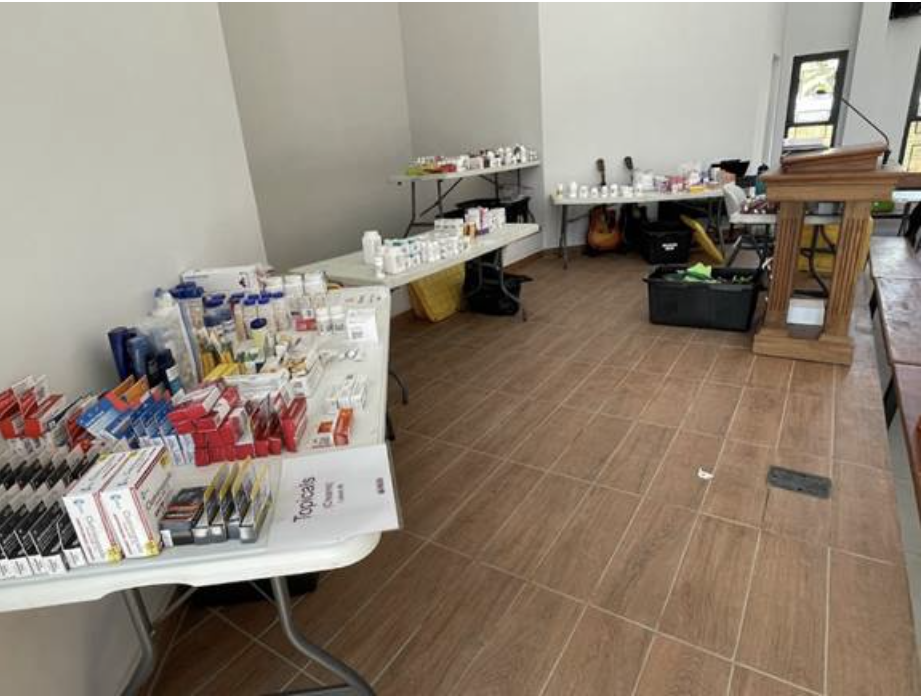
One of our pharmacies, sorted and ready to go.
Regardless of whether you’re doing disaster relief or medical missions, there are limitations that you have to work within, which is where your pharmacy knowledge gets a chance to shine. While it would be nice to have access to all the medications we can get in the United States, unfortunately that’s unlikely to be the case in relief work. Whether you’re working with medicines shipped in or purchased locally, there’s probably a limited formulary of only essential medicines. There may be some medicines you need depending on the scenario or community needs. (For example, if you’re going into Madagascar you may want to make sure you have ciprofloxacin to treat the plague.)
Rarely - if ever - will there be controlled substances, such as opioids or benzodiazepines, on a medical mission trip. And for people like me, who are clinical institutional pharmacists, a refresher on some basics, like how to dose amoxicillin for tonsillitis, is essential. I always have to refresh on H. pylori and STI treatment regimens because I don’t see those often in my practice. Also, just try coming up with an H. pylori treatment regimen when you don’t have bismuth or clarithromycin! It can be tough, even more so now that the guideline’s first-line regimens use vonaprazan, which is not available in most countries and cost-prohibitive.
The other aspect of being a pharmacist in relief work is managing your formulary supply. On a medical mission trip, odds are you won’t be able to restock the majority of your meds, so what you have at the beginning of the trip is all you will have. For a disaster response that lasts several weeks, you may get a resupply… But it takes time to make that happen, and you need to monitor usage rates to avoid a stock out. This requires significant communication with the providers so they are aware of stock levels and can adjust their prescribing habits to reduce or increase use of a specific drug.
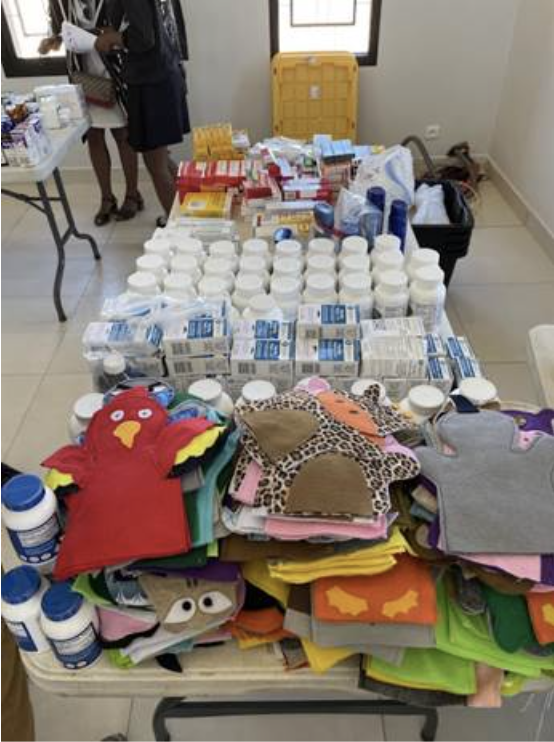
Another of our pharmacies. When I say limited options, I mean limited options. You get creative.
For example, because of the bulk and weight of creams, we usually take a limited amount of permethrin cream to treat scabies. However, there’s always a plentiful supply of ivermectin since tablets are so much lighter and easier to pack. I’m constantly running to providers to talk through the change I want to make to their prescriptions in order to best utilize the stock I have. At times, I’ll go look at the patient with the doctor, and we decide on a treatment regimen together that best meets the patient’s needs - but also works for our stock.
There are multiple reasons pharmacists are crucial for relief work. First, pharmacists have unique expertise in designing treatment regimens with limited resources. We have the ability to be creative and problem solve because of our deep knowledge of the medicines that other healthcare professionals do not have. Antimicrobial stewardship is another huge reason for pharmacists to be involved in relief work. Over prescribing of antibiotics is a significant problem that we are able to address. Whether it’s getting the antibiotics deprescribed because the patient likely has a viral respiratory illness or switching to an alternative, more narrow spectrum agent, we can reduce the harm that is done by international teams overprescribing antibiotics.
(Side note, there’s a book called “When Helping Hurts” that I’d recommend to anyone interested in international work.)
Another unique benefit of a pharmacist working on an international relief team is our willingness to intervene on the patient’s behalf. I had a situation recently on a trip where a relatively new nurse practitioner was seeing a patient with what they suspected was an acute heart failure exacerbation. We didn’t have furosemide so she prescribed hydrochlorothiazide, assuming that because it’s also a diuretic, it would be better than nothing for helping with the lower extremity edema. I had the opportunity to discuss with her why hydrochlorothiazide would not be helpful and that we really needed to send this patient to the ER for evaluation. Because I could explain to her the difference in the mechanisms of action of furosemide and hydrochlorothiazide, she understood that her treatment would not work and agreed to send the patient to the ER.
There are few things more rewarding and exhausting than international relief work, and I can guarantee you will not regret it. If you have an interest in bringing medical help to people in need around the world through pharmacy, we need you. Check out medical NGOs and medical mission organizations to see if any of it is feasible for you!