Everything You Need to Know about the Uniform MPJE
Carley’s Note: If you’re reading this, then chances are you’ve had to take the MPJE before getting licensed, or you are preparing to take your MPJE in order to get licensed. In fact, some of you have gone through the dread of taking the MPJE numerous times (and paying hundreds of dollars) in order to get your license in more than one state.
We've all been there...locking ourselves in our room for weeks, chugging caffeine, trying to memorize whether a specific state needs a certain countertop size or requires records to be kept in a specific location. It's always been messy, exhausting, and an expensive hurdle to our career flexibility. But things are changing - read on to see how!
There is massive news that is completely transforming how we look at pharmacy law exam study prep. The National Association of Boards of Pharmacy (NABP) has shaken things up by introducing a uniform version of the exam - the Uniform Multistate Pharmacy Jurisprudence Examination (UMPJE).
Now, this isn't a far-off future concept...it's happening right now! The transition kicked off with early adopter states starting back on April 1, 2026, and another wave of states such as Florida, Maryland, and West Virginia adopted the format over the summer. If you're testing this year, the game has completely changed. Since this is a rolling change, it's important as you're preparing your study plan that you confirm with NABP if your state will be administering the Uniform version, or if you should stick to your original state-specific MPJE materials.
So, What the Heck is the UMPJE Anyway?
Think of the UMPJE as the common denominator of pharmacy law. Instead of stressing about overly specific rules for a single state board, it tests universal state-law concepts alongside the standard federal regulations.

Us realizing NABP is unveiling an ALL NEW uniform law exam that could help pharmacists get licensed countrywide.
This is an important distinction to make - the UMPJE is NOT a solely federal law exam. The exam is based on pharmacy concepts that are universal across the majority of states. Think pharmacy supervision rules...in every state across the country there is some form of guidance on who is allowed in the pharmacy, and it typically requires a pharmacist present. This would be an example of one of those universal rules that will apply to most of the country, even though it isn't a federal law; this makes it fair game for the UMPJE. (Image)
UMPJE vs. Traditional MPJE: The Breakdown
Now that you know what it's testing, let's talk about the actual testing experience, because the question format got a TOTAL makeover.
The NABP has completely ditched the traditional 5-option layouts and the terrifying nightmare of "select all that apply". Instead, you're now looking at a straightforward, 3-option multiple choice format (A, B, or C only). That's right...no more K-type questions, and no more "select all that apply" misery! That said, the clinical scenarios are still adaptive and rigorous. The setup itself is just more clean now.
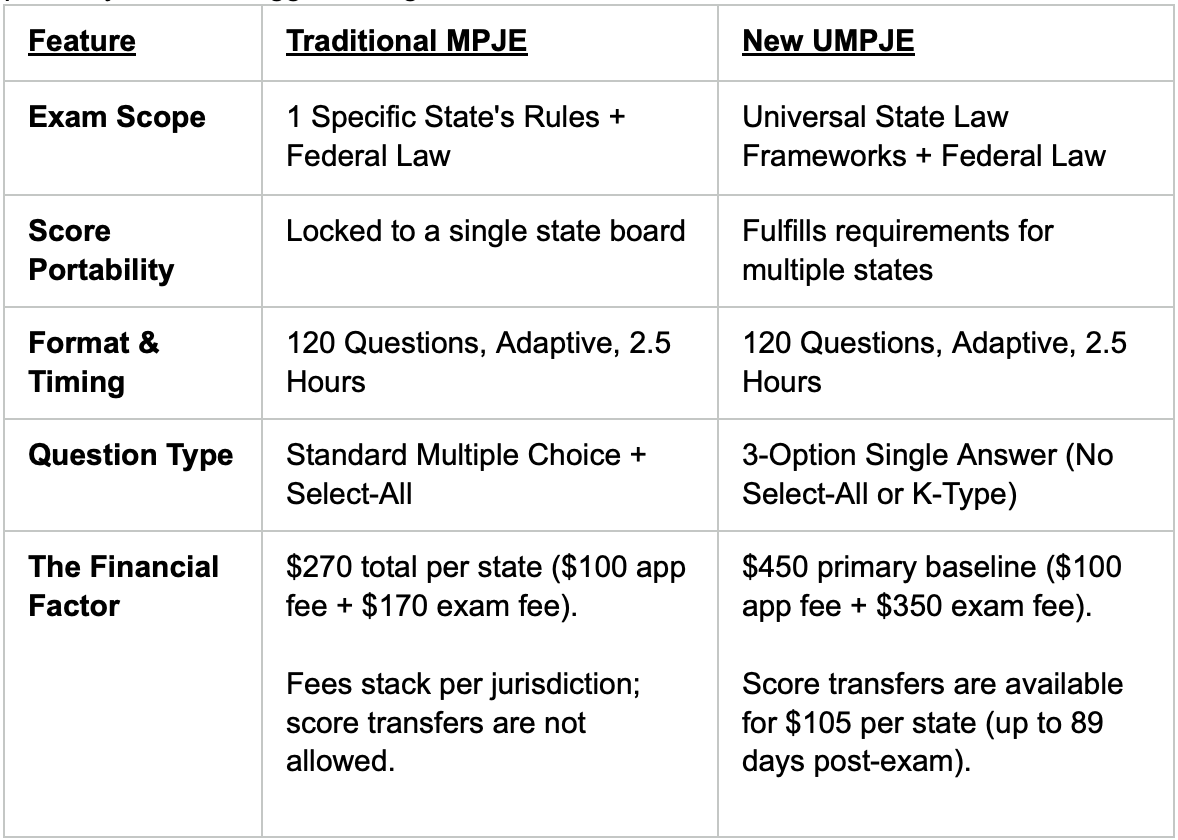
Here's a quick look at the mechanics of the new exam compared to the old system you've probably had to struggle through:
(If you want to hear more about the shift from the test-writers themselves, you can check out an official video on the differences between the two exams here).
When looking at those fee numbers, the cost-effectiveness of this new system is a massive win if you’re trying to get licensed in multiple states. Under the old system, a three-state license meant paying the $270 fee three separate times ($810 total) and physically sitting through three painful, separate exams. With the UMPJE, you take one single exam for the $450 baseline, and then just buy score transfers for $105 per additional state. For those same three states, you’re looking at a total of $660. That’s $150 back in your pocket, and two fewer test days you have to sit through (time is money, you know).
Outside of the new question format, the basic testing setup is the exact same! There are still 120 total questions, 20 of which are ungraded “pre-test” questions, a 2.5 hour time limit, and it’s still adaptive (difficulty increases as you answer questions correctly). Now, just because the structure is the same, that doesn’t mean your preparation strategy will be! Your focus will shift from single-state facts to understanding big-picture legal concepts…but more on that in a bit. :)
As we said before, this is a rolling process. Keep in mind that individual states still choose whether they want to opt-in to the UMPJE. While most are moving this way, a few may still request a smaller, secondary “Plus Module” quiz to cover their truly unique local laws. Regardless, your main hurdle is in the process of being unified, and we think that’s pretty cool over here.
Translating the 4 Core Content Domains
With a new exam structure comes new mapping of the content domains. We’re super thankful to our friends at NABP who have already published the official NABP UMPJE Content Outline, but would it be us if we didn’t break it down with you? Let’s take a closer look at each domain and what exactly you’ll be studying:
Domain 1: Pharmacy and Pharmacist Practice (30%): Who Can Do What?
This is all about your day-to-day legal boundaries and keeping everyone safe. Think of it as the "rules of engagement" for your license. You’ll tackle real-world scenarios testing technician supervision scenarios, what you can legally do in a collaborative practice agreement, and keeping patient data completely safe for HIPAA. It also hits tracking and safety standards like the Drug Supply Chain Security Act (DSCSA), OSHA rules, and the big three USP compounding chapters (795, 797, and 800).
Domain 2: Medication Use Process (30%): The Lifecycle of a Drug
This tracks the literal path a drug takes from the second a prescriber writes it to the moment a patient walks out the front door with it. It’s heavy on practical workflow legalities. You’ll need to master the requirements for a valid prescription, when you can legally give an emergency refill, and how generic substitutions work. This is also where your "corresponding responsibility" as a pharmacist gets tested, along with logging into the PDMP and hitting your OBRA ‘90 mandates like prospective DURs and patient counseling.
Domain 3: Regulatory Authority and Legal Obligations (20%): The Rulemakers and Compliance
This domain deals with the agencies that keep tabs on us, like the FDA, DEA, and State Boards, and what actually happens when they walk through your door for an audit or inspection. The questions here love to target the rules surrounding controlled substances. You’ll want to know how to manage inventory, sign off on DEA order forms, handle power of attorney, report a theft or loss without panicking, and properly dispose of expired or wasted controls.
Domain 4: Pharmacy Operations (20%): The Physical Building and the Paperwork

Every pharmacy student/pharmacist ever, studying countertop sizes. But no more!
This one focuses on the brick-and-mortar facility and the tech we use every day. It’s less about clinical scenarios and more about how the physical pharmacy runs legally. You'll face questions about pharmacy licensures, automated dispensing cabinets, and the legalities behind electronic or faxed prescribing tech. It also heavily tests security protocols like who is physically allowed past the counter, how medications must be stored, and department security when the pharmacist steps away. (Image)
How to Hack Your Study Strategy
Now, as I alluded to before, because the target has shifted, the way you study has to adapt too. Here is how to approach it logically without losing your sanity:
Leave the Hyper-Specifics Behind: If you are currently reviewing a law that sounds super specific to one area or state, go ahead and close that tab. The UMPJE is looking to test concepts that are uniform across most states, so it won’t be testing overly specific regulations that are region or state-specific.
Focus on the Common Denominator: Look for standard, across-the-board legal protocols. The NABP Model Pharmacy Acts/Rules are a great place to start for this, as they provide the State Boards with model language that they can use when developing their own state laws or board rules. If while reviewing you notice that a vast majority of states handle a process the exact same way based on standard national pharmacy models, that is exactly what the UMPJE is going to target.
Master the Federal Frameworks: While not a solely-federal exam, this new structure means federal law is more important than ever. You need to know the Controlled Substances Act (CSA) backward and forward, especially drug scheduling, ordering processes, and prescription validation rules. From there, make sure you are completely bulletproof on the Food, Drug, and Cosmetic Act (FDCA) (specifically how to spot adulteration vs. misbranding), the Poison Prevention Packaging Act (PPPA) (child-resistant cap exemptions), the Combat Methamphetamine Epidemic Act (CMEA) (pseudoephedrine sales and logbook limits), and the Drug Quality and Security Act (DQSA) (the clear lines separating 503A traditional compounding from 503B outsourcing facilities).
Budget by Domain Weighting: If you are short on study time (no judgment here), budget your time wisely based on the blueprint weights. Since the first two domains make up a huge 60% chunk of your total score, that is where the bulk of your energy should go.
The tl;dr Way to Prepare
A quick word of warning before you buy any study materials - if you try to pass this new exam format using solely state law study guides or state-specific MPJE question banks, you will end up spending hours memorizing nuanced rules while leaving massive blind spots on the new national standards.
You didn’t think we’d leave you hanging though, did you? We knew our friends needed something that would cut through the chaos…so we built two brand new resources to get you through test day like a star!
First is our brand new UMPJE Cheat Sheet. It’s similar to our other MPJE study guides, but now with all of that uniform and federal information digested and summarized for your studying benefit. Think of it as us reading the giant law textbook for you to tease out the really juicy important bits. If you’ve used one of our MPJE study guides before, this one should feel like a familiar upgrade.
Second, our UMPJE Practice Test features realistic, scenario-based questions that mimic the exact formatting of the UMPJE. That’s right, they’re already 3-option multiple choice in order for you to familiarize yourself with the new testing style. These questions were drafted based on the 4 UMPJE domains and can help teach you the logic behind the laws so you don’t get tripped up by tricky test wording.
The tl;dr on the UMPJE
Ultimately, the UMPJE is a massive win for your ability to practice in numerous states. Just keep in mind that while it leans heavily on national frameworks, it isn't just a federal law exam - it focuses on universal state-level concepts that apply across the board.

Regardless, gone are the days of drowning in super specific state laws and the misery of "select all that apply" questions; instead, you get a clean, updated, 3-answer option format to work with! Be sure to double check if your state has opted-in and if so, don’t forget that we have the UMPJE Cheat Sheet and UMPJE Practice Test to help you sort through the transition chaos without losing your mind. We did the heavy lifting so you can walk into the testing center feeling completely unstoppable on exam day. You already survived the gauntlet of pharmacy school…you are more than ready to clear this final, uniform hurdle and add your next state to the licensure roster! (Image)