The tl;dr Pharmacy Journal Club: Daraxonrasib in Metastatic Pancreatic Cancer - The RASolute 302 Trial
Steph’s Note: This week, we have a treat. This, people, is a journal club. Not just any journal club, but a prime example of how journal club should be done. Read it, soak it in, admire the thought that went into critically assessing each bit of the study, and then go forth and use those skills and knowledge on other studies. Who is teaching us these skills? One Bryce Beckstrom, who has the pleasure of being Brandon’s resident this year :)
Bryce Beckstrom, PharmD, is a 2026 graduate of The University of Texas at Austin College of Pharmacy and is currently completing an NCODA Medically Integrated Oncology Pharmacy residency at Texas Oncology. His professional interests include pharmacy leadership and patient education. Outside of pharmacy, he enjoys story-driven video games, trying new restaurants, and finding new boba spots with friends.
Have we finally found a way to deal with RAS being stuck “ON”?
We need to start this journal club with a bit of a plot twist.
When the RASolute 302 trial was published online in The New England Journal of Medicine on May 31, 2026, daraxonrasib was still an investigational drug. Less than three months later, on August 26, 2026, the FDA approved daraxonrasib - now branded RASONQUE - for adults with metastatic pancreatic adenocarcinoma who have received at least one prior systemic therapy or who are not candidates for multiagent systemic therapy.

Daraxonrasib, less than 3 months after RASolute 302 was published.
So unlike many journal clubs where we stare at a promising investigational drug and wonder whether it will ever make it to a pharmacy shelf, this one has already crossed that finish line. (Image)
And the study that got it there? RASolute 302: daraxonrasib versus chemotherapy in previously treated metastatic pancreatic ductal adenocarcinoma.
Spoiler alert: the results are not subtle.
But before we jump straight to the results (hint hint: hazard ratio of 0.40 sounds promising) and collectively lose our pharmacist minds, we need some context.
Why do we need another treatment for metastatic pancreatic cancer?
Setting the stage, pancreatic ductal adenocarcinoma, or PDAC, is not exactly a cancer that gives us much time or options for effective treatment. Across pancreatic cancer overall, approximately 52% of patients are diagnosed after the disease has already spread to distant sites, while only about 15% are diagnosed when disease remains localized. Of those with distant-stage disease, the five-year relative survival is only about 3.4%.
In patients with metastatic PDAC, median overall survival has historically remained less than one year. And once patients progress through their first systemic regimen, things get even tougher. Second-line chemotherapy typically produces relatively low response rates, with median progression-free survival of roughly 3-4 months, and median overall survival of around 6-7 months.
On top of that, there hasn’t historically been one universally accepted “second-line pancreatic cancer regimen.” Instead, treatment usually depends on what the patient received first.
For a patient who received FOLFIRINOX first, gemcitabine + nab-paclitaxel is a reasonable second-line option. After a gemcitabine-based regimen, 5-FU + nanoliposomal irinotecan is generally preferred. Fluorouracil/oxaliplatin regimens such as FOLFOX can also be considered, although the clinical trial evidence there has been somewhat inconsistent. And all of these more aggressive options are generally intended for patients with good performance status. You can imagine though, at this stage in their prognosis that can be difficult to come by.
And so, we have a disease that is commonly metastatic at diagnosis, almost inevitably requires additional treatment when first-line therapy stops working, and historically leaves us choosing among highly cytotoxic regimens with fairly modest efficacy.
Not ideal. So that brings us back to our original question of why do we need another treatment for metastatic pancreatic cancer? As you can see, there isn’t really one.
There is, however, one extremely promising molecular target hiding in plain sight.
RAS: The molecular switch that forgot how to turn off
More than 90% of PDAC tumors contain an oncogenic mutation on RAS, with the vast majority occurring in KRAS. If you haven’t thought about the RAS signaling pathway since pharmacy school, here’s a quick refresher.
RAS is basically a tiny molecular switch. When RAS is bound to GDP, it is in its inactive or OFF state. When GDP is exchanged for GTP, RAS moves into its active or ON state and can interact with downstream effector proteins that activate pathways including RAF-MEK-ERK and PI3K-AKT. Those pathways tell cells to do things like grow and survive.
Two groups of regulatory proteins help control the switch:
GEFs, or guanine nucleotide exchange factors, promote release of GDP so GTP can bind and turn RAS ON.
GAPs, or GTPase-activating proteins, accelerate hydrolysis of GTP to GDP, helping return RAS to the OFF state.
One small technical distinction worth making here: GEFs don’t literally “add GTP” to RAS, and GAPs don’t just yank GTP off. Think of GEFs as facilitating the nucleotide exchange of GDP to GTP, while GAPs accelerate the chemical hydrolysis of GTP back to GDP.
Oncogenic RAS mutations can impair that hydrolysis step. And if RAS can’t efficiently make its way back to GDP?
Well…the switch spends far too much time stuck ON, continuously telling the cell to grow. (Image) (Image)
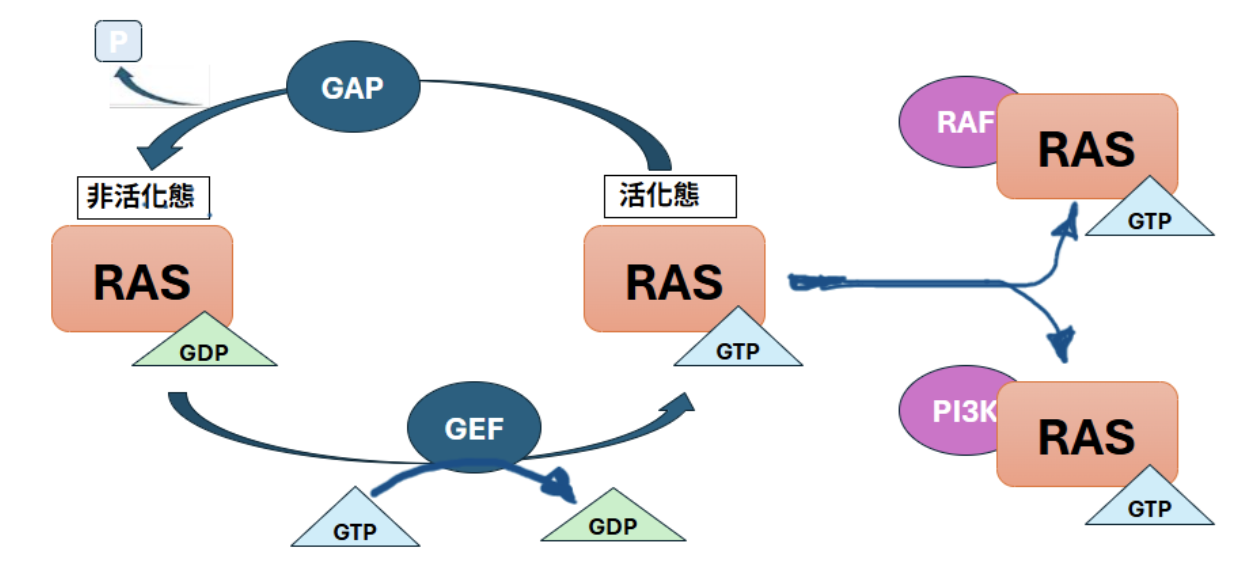
RAS is basically a molecular switch. GEFs promote GDP-to-GTP exchange to turn RAS ON, while GAPs accelerate GTP hydrolysis to return RAS to the GDP-bound OFF state. Oncogenic RAS mutations can interfere with that OFF switch, leaving growth signaling persistently activated.
So what makes daraxonrasib different?

Normal RAS: ON → OFF → ON → OFF
Oncogenic RAS: “Have you tried turning it OFF?”
Pancreatic cancer: “No.”
RAS has historically been a frustrating drug target. The first successful direct KRAS inhibitors, such as those targeting KRAS G12C, work by binding an allele-specific pocket and trapping KRAS primarily in its inactive GDP-bound state. That was an enormous scientific breakthrough.
Unfortunately for pancreatic cancer, G12C occurs in only around 1-2% of PDAC, while G12D, G12V, and G12R are dramatically more common.
Daraxonrasib takes a different approach. It is an oral, RAS(ON) multiselective tri-complex inhibitor. Yes, that is a lot of words.
The important pieces are:
It targets RAS while RAS is ON.
Instead of waiting for the protein to enter its inactive GDP-bound off state, daraxonrasib functions at the active GTP-bound conformation.
It isn’t designed around one single mutant allele like past RAS inhibitors.
Daraxonrasib has activity across multiple mutant forms of KRAS, NRAS, and HRAS, as well as wild-type RAS.
It recruits a helper protein.
Daraxonrasib first binds the intracellular chaperone cyclophilin A (CypA). That daraxonrasib-CypA complex then binds RAS(ON), creating the “tri-complex”. The recruited CypA essentially becomes a bulky molecular roadblock that prevents activated RAS from interacting with downstream effector proteins to keep things off.
But it gets even more interesting.
Preclinical mechanistic work suggests this tri-complex inhibitors does two things: physically blocks activated RAS from signaling downstream and stimulating GTP hydrolysis and encourages mutant RAS to move back toward the GDP-bound OFF state.
So when asking, “Why might this be advantageous compared to just shutting RAS down like previous drugs have?” The careful answer is not that RAS(ON) inhibition is universally superior to every other RAS inhibitor...
But the advantage is that this mechanism directly attacks the active signaling state across a much broader collection of RAS variants, rather than being restricted to an uncommon allele such as G12C. And in PDAC, where the common mutations are G12D, G12V, and G12R rather than G12C, that is a very big deal for target therapy.
Enter the RASolute 302 Study
The paper we’re discussing is:
O’Reilly EM, Wainberg ZA, Hendifar AE, et al. Daraxonrasib or Chemotherapy in Previously Treated Metastatic Pancreatic Cancer. N Engl J Med. 2026;395:325-337.
RASolute 302 was a phase 3, international, open-label, randomized trial comparing daraxonrasib with investigator-selected chemotherapy. Phase 3 is important here. We’re well beyond “does this molecule hit the target?” territory. At this point, we’re asking whether the drug actually performs better than what treatment real patients would otherwise receive.
A total of 500 patients at 59 sites in six countries were randomized 1:1 into the two arms being:
Daraxonrasib 300 mg orally once daily, or
Investigator’s choice of:
gemcitabine + nab-paclitaxel,
modified FOLFIRINOX,
FOLFOX, or
liposomal irinotecan + fluorouracil + leucovorin
Treatment continued until progression, unacceptable toxicity, or withdrawal. No crossover was allowed. Were those arms of chemotherapy comparators reasonable?
Broadly, yes.
Remember there isn’t one universal second-line regimen in mPDAC because the appropriate choice depends heavily on what was used first. ASCO guidance supports gemcitabine/nab-paclitaxel after FOLFIRINOX and prefers fluorouracil/nanoliposomal irinotecan after gemcitabine-based therapy in sufficiently fit patients. Fluorouracil/oxaliplatin is another possible option, although evidence has been conflicting.
And the actual chemotherapy distribution in RASolute 302 makes this even more reassuring:
56.5% received gemcitabine/nab-paclitaxel
32.7% received liposomal irinotecan + 5-FU/leucovorin
5.6% received modified FOLFIRINOX
5.1% received FOLFOX
So the control arm wasn’t some suspiciously weak throwaway comparator created so that the shiny new drug could win. It largely reflected recognizable clinical practice.
Who could get into the study?
Patients needed to:
Be at least 18 years old
Have confirmed metastatic PDAC
Have progressed after one previous line of fluoropyrimidine- or gemcitabine-based therapy for metastatic disease
Or develop metastatic disease within 6 months of finishing neoadjuvant/adjuvant treatment
Have measurable disease by RECIST v1.1
Have an ECOG performance status of 0 or 1
Have adequate organ function
Have documented RAS status
Patients with prior RAS-targeted therapy or known CNS metastases were excluded. This makes sense because they didn’t want any cross efficacy from previous target therapy skewing the results. As for no known CNS metastasis, these are well known to be very poor prognosis/life expectancy, which could largely confound the survival endpoints.
But didn’t they include only ECOG scores of 0 or 1? That ECOG 0-1 requirement deserves some attention.
Remember: this is metastatic pancreatic cancer after previous treatment. Are all of our patients in that state going to have pristine organ function and ECOG 0-1?
Definitely not.
But the requirement isn’t completely disconnected from how second-line chemotherapy is already used. ASCO similarly reserves the more aggressive combination second-line regimens for patients with ECOG 0-1 and relatively favorable comorbidity profiles. Patients with ECOG 2 may receive less intensive therapy, while for ECOG ≥3 the emphasis increasingly shifts toward supportive care.
So I wouldn’t call the study population unrealistic. I would call it the fitter subset of real-world second-line mPDAC patients. And that matters when we later ask how confidently we can extrapolate these results to someone with significant functional decline, organ dysfunction, or ECOG 2-3.
But first a word about who paid for all of this.
RASolute 302 was funded by Revolution Medicines, the manufacturer of daraxonrasib. The sponsor collaborated with investigators on the protocol, and the statistical analyses were performed and validated by the sponsor according to a prespecified statistical analysis plan.
Should our pharmacist eyebrows go up a little? Sure.
Should we immediately throw the article in the trash because the manufacturer funded its own phase 3 drug-development trial? No.
In this case, some reassuring features include a prespecified statistical plan, randomized design, blinded independent central review (BICR) of PFS, objective overall survival data, multiplicity control, and no crossover.
So, yellow highlighter. Not red sharpie. Back to the good stuff.
What were they actually measuring as endpoints?
RASolute 302 had two primary endpoints, both evaluated first in patients with RAS G12 mutations:
Overall survival
Progression-free survival, assessed by blinded independent central review using RECIST v1.1
Why the focus on G12? Because those mutations make up the overwhelming majority of RAS alterations in PDAC. Infact, ultimately 91.8% of the trial population had RAS G12 disease.
Key secondary endpoints included:
OS in the overall population
PFS in the overall population
Objective response
Time to deterioration of pancreatic-cancer-related pain
Time to deterioration in global health status/quality of life
Safety was also evaluated.
The patient-reported endpoints are particularly nice to see in a metastatic pancreatic cancer study. Living longer is obviously important, but how patients feel during the additional time matters a lot too. There is one nuance we’ll come back to: both time-to-deterioration measures counted death as an event. Keep that filed away for now.
Okay, statistics time.
Don’t leave.
Please.
The researchers used Kaplan-Meier analysis for OS and PFS. Why Kaplan-Meier? Because not every patient has the event we’re interested in before the study analysis occurs.
At data cutoff:
some patients have died or progressed,
some are still alive without progression,
and some simply haven’t been followed long enough yet.
Kaplan-Meier analysis allows researchers to use the information contributed by all those patients while accounting for censoring.
The treatment groups were compared with a stratified log-rank test, and hazard ratios were estimated using a stratified Cox proportional-hazards model. The simplest practical interpretation of a hazard ratio:
HR = 1: no difference in event hazard
HR < 1: favors daraxonrasib
HR > 1: favors chemotherapy
And one very important statistics PSA: an HR of 0.40 does not mean “40% of patients died” or that there was a 60-percentage-point reduction in deaths. It means the estimated hazard of death over the observed time period was approximately 60% lower in the daraxonrasib group than in the comparator group, assuming the model is appropriate.
Multiplicity, because apparently two primary endpoints weren’t enough fun.
The investigators controlled the overall two-sided type I error at 5% using a graphical multiple-testing procedure. Initially, 4.8% alpha went to OS, and 0.2% went to PFS. Testing then proceeded hierarchically through the RAS G12 endpoints, overall-population endpoints, objective response, and patient-reported outcomes.
That matters because if you test enough endpoints repeatedly at P < 0.05, eventually something will look positive just by chance. Here, the statistical plan made the study earn its way down the endpoint list.
The study designers planned for an OS hazard ratio of 0.70 and a PFS hazard ratio of 0.54. Remember those numbers. We are about to have some fun with them.
Now, on to the study results!
A total of 500 patients underwent randomization: 248 to daraxonrasib and 252 to chemotherapy. Of those, 459 patients - 91.8% - had RAS G12 mutations.
Baseline characteristics were pretty well balanced. Median age was around 65-66 years, which is also around the age of real life patients dealing with mPDAC. Roughly half of the patients had ECOG 0 and half ECOG 1. About 70% had liver metastases. Prior metastatic treatment was primarily FOLFIRINOX or gemcitabine/nab-paclitaxel. Now for the important part.
Overall survival: RAS G12 population
Median OS was: Daraxonrasib: 13.2 months, Chemotherapy: 6.6 months, HR 0.40; 95% CI 0.30 - 0.54; P < 0.001
Median overall survival was essentially doubled. At 12 months, 53.3% of patients receiving daraxonrasib were alive compared to 18.7% receiving chemotherapy. Let that sink in.
Progression-free survival: RAS G12 population
Median PFS was: Daraxonrasib: 7.3 months, Chemotherapy: 3.5 months, HR 0.45; 95% CI 0.34 - 0.59; P < 0.001

“We’ll power OS assuming HR = 0.70.”
“RASolute 302 reports HR = 0.40.”
Again: approximately double the median. And recall that the trial designers powered the OS comparison around an anticipated HR of 0.70. They got 0.40. (Image)
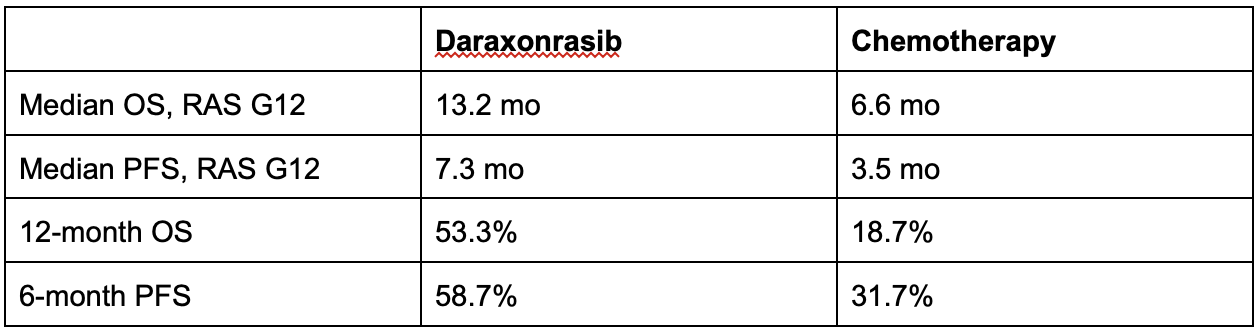
Not exactly a photo finish. In the RAS G12 population, median OS and PFS were both approximately doubled with daraxonrasib compared with investigator-selected chemotherapy.
What about the overall population?
Pretty much the same story.
Overall survival was: Daraxonrasib: 13.2 months, Chemotherapy: 6.7 months, HR 0.40; 95% CI 0.30 - 0.53; P < 0.001
Progression-free survival was: Daraxonrasib: 7.2 months, Chemotherapy: 3.6 months, HR 0.49; 95% CI 0.38-0.64; P < 0.001
Objective response:
RAS G12 population: 33.2% vs 11.8%
Overall population: 31.6% vs 11.2%
So patients receiving daraxonrasib were not only living longer before progressing, but the tumors were also substantially more likely to demonstrate an objective response.
And did patients actually feel better?
Or, perhaps more accurately: did they avoid feeling worse for longer? In the RAS G12 population, median time to pain deterioration was: 9.0 months with daraxonrasib vs 3.7 months with chemotherapy, HR 0.51; P < 0.001.
The median time to deterioration in global health status/quality of life was 5.6 vs 2.4 months, HR 0.60; P < 0.001.
That’s reassuring. A survival benefit is much easier to celebrate when we’re not simply buying months of progressively worse symptoms and toxicity. But here comes that caveat we filed away earlier.
For these endpoints, death itself counted as deterioration. Because daraxonrasib produced such a large survival advantage, fewer early deaths will automatically make these time-to-deterioration composites look better. That doesn’t make the results invalid. It just means I would resist translating these numbers into “daraxonrasib independently prevented pain for 5 extra months.” The endpoint is partly measuring symptom deterioration and partly measuring survival. That is an important distinction.
What about patients without G12 mutations?
Proceed carefully.
There were only 41 non-G12 patients in the entire trial. For OS, the exploratory hazard ratio was 0.37. Sounds great. For PFS? HR 1.38; 95% CI 0.60-3.17.
That confidence interval is basically waving a giant sign saying, “PLEASE DO NOT BUILD A STRONG CONCLUSION FROM ME.”
The authors appropriately describe these subgroup findings as exploratory. Since more than 90% of enrolled patients had G12 disease, the nearly identical results in the “overall population” and G12 population are primarily reflecting the same patients.
This becomes particularly interesting now that daraxonrasib is approved. The FDA indication is not written as being limited to RAS G12-mutated disease; it covers adults with metastatic pancreatic adenocarcinoma after prior systemic therapy or those unable to receive multiagent therapy.
So clinically, the label is broader than the population in whom the randomized evidence is most mature.
Something worth remembering.
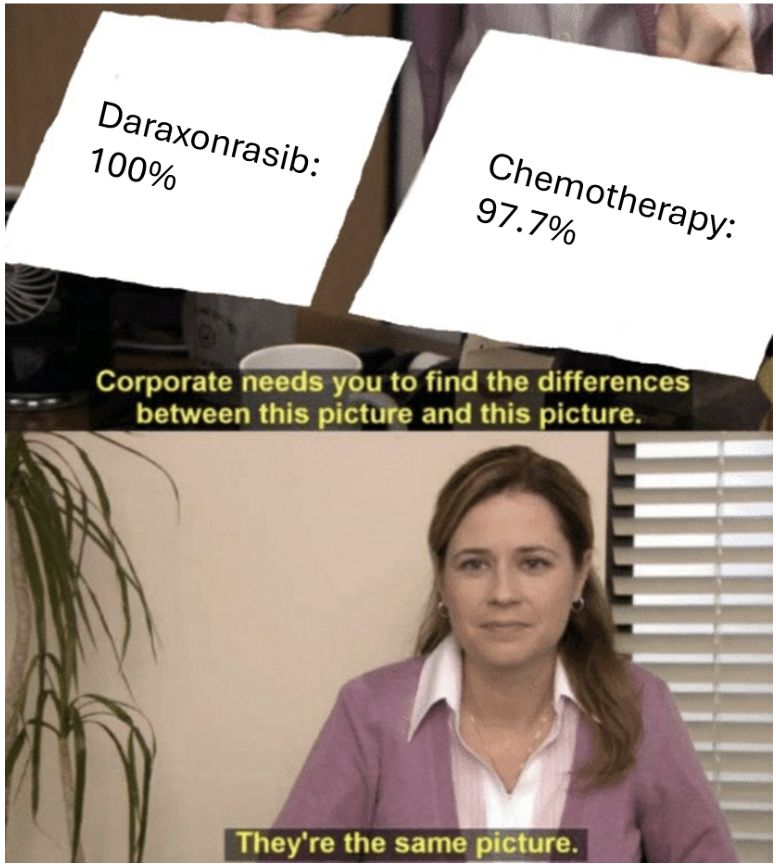
If you stop reading the safety table at “any adverse event,” you miss basically the entire clinically useful part.
Now let’s talk toxicity.
Here’s one way to look at RASolute 302 safety:
Any adverse event:
Daraxonrasib: 100%
Chemotherapy: 97.7%
Wow.
Much difference. (Image)
Very toxicity.
But hold on! Once we move beyond whether anything happened to how bad it was, the story changes.
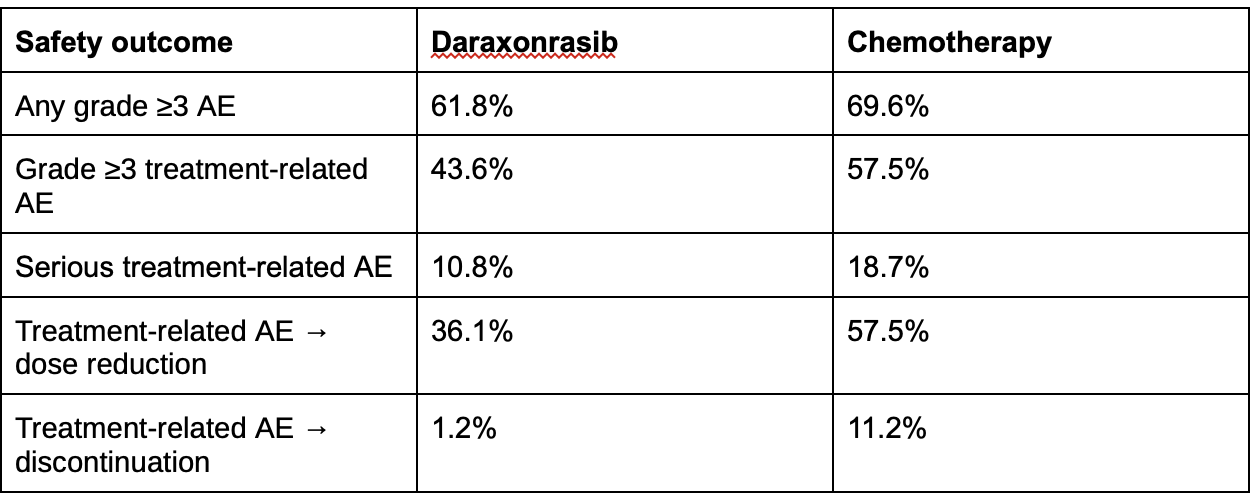

And remember that median treatment exposure was 6.2 months with daraxonrasib, compared with only approximately 1.5-3.2 months depending on the chemotherapy regimen.
So despite patients being exposed to daraxonrasib for substantially longer, severe toxicity, dose reductions, and especially treatment discontinuations were less common. Yes, virtually everybody had something happen, but those top-line “any AE” percentages make the treatments look much more similar than they actually were from a tolerability standpoint.
What does daraxonrasib toxicity actually look like?
It is much less “cytotoxic chemotherapy” and much more “RAS pathway inhibition.” The most common treatment-related adverse events were:
Rash - 85.5%
Diarrhea - 58.1%
Stomatitis - 53.1%
Nausea - 46.5%
Vomiting - 36.9%
Grade ≥3 rash occurred in 13.7% and grade ≥3 stomatitis in 12.0%.
Chemotherapy, meanwhile, produced much more of the familiar hematologic and neurologic toxicity:
Grade ≥3 neutropenia: 27.6% chemotherapy vs 1.7% daraxonrasib
Grade ≥3 anemia: 16.4% vs 4.1%
Any-grade peripheral neuropathy: 25.2% vs 1.7%
One patient receiving daraxonrasib died from treatment-related pneumonitis, so the tolerability advantage should certainly not be interpreted as “this drug can’t cause serious toxicity.” More accurately, the toxicity profiles are different and, overall, it appears easier to keep patients on treatment through than the chemotherapy comparators.
Pharmacist hat on: rash management is going to matter
Since RASONQUE is now actually on the market, we get to go one step beyond journal club and ask, “What do we do with that 85% rash rate?”
Current RASONQUE guidance recommends starting dermatologic prophylaxis prior to treatment, including:
topical corticosteroid to the face and chest,
fragrance-free emollient,
limiting sun exposure and using SPF ≥30, and
considering prophylactic oral doxycycline or minocycline.
Median onset of dermatologic toxicity in pancreatic-cancer trials was only 13 days, so this isn’t something to wait around and address at the patient's third follow-up visit.
This is exactly where pharmacists can have a meaningful role: proactive counseling, prophylaxis, medication access, drug-interaction review, and early toxicity intervention to keep patients on therapy.
So what do we like about RASolute 302?
A lot, actually. First, overall survival was a primary endpoint. We don’t have to spend 15 paragraphs arguing about whether a biomarker or radiographic surrogate will eventually translate to patients living longer.
They lived longer.
Second, the effect size was substantial and internally consistent. OS, PFS, response rate, pain deterioration, global health/QoL all moved in the same general direction.
Third, PFS was evaluated by blinded independent central review, which is particularly helpful in an otherwise open-label trial.
Fourth, the researchers controlled for multiplicity rather than fishing through a pile of endpoints until something turned statistically consistent.
Fifth, crossover wasn’t allowed, which makes the overall-survival difference considerably cleaner to interpret.
And finally, the chemotherapy arm behaved about how we would expect historically. A median OS around 6-7 (six-seven???) months in previously treated mPDAC is unfortunately very believable. In other words, the giant difference doesn’t appear to have emerged because the control arm had some inexplicably terrible outcome.
And what makes the pharmacist eyebrow go up?
There are a few things.
1. This was open label
Patients and investigators knew whether someone was receiving a once-daily targeted oral agent or chemotherapy. Some of that was practically unavoidable. Creating matching placebos and sham infusions for several investigator-selected chemotherapy regimens would have been a logistical nightmare. And OS is pretty hard to subjectively bias. BICR also helps protect PFS assessment.
But open-label knowledge can affect softer decisions: adverse-event attribution, treatment modification, withdrawal, and whether a patient ever initiates assigned therapy. Which brings us to…
2. A lot more chemotherapy patients never started treatment
15.1% of patients assigned to chemotherapy never received it. Only 2.8% of patients assigned to daraxonrasib failed to start treatment. Most of the difference came from patients withdrawing after randomization.
That’s not a trivial imbalance.
The efficacy analysis appropriately used the randomized population, but if patients learn they’re assigned to conventional chemotherapy and then disproportionately decide not to take it, that can potentially disadvantage the chemotherapy arm. The investigators acknowledge this possibility.
At the same time, chemotherapy outcomes remained consistent with historical send-line benchmarks, which makes it difficult to argue that this issue alone explains an OS hazard ratio of 0.40. Still, definitely something that belongs in the limitations column.
3. The OS data is still relatively early
The reported analysis was the first planned interim analysis for OS, and median follow-up was only 8.5 months. The estimated median OS with daraxonrasib was 13.2 months, but the upper bound of its 95% confidence interval had not yet been reached.
This doesn’t negate the result - the observed difference is enormous - but longer follow-up will provide a much better idea of durability and late toxicity.
4. These were fit patients
ECOG 0-1. Adequate organ function. These are the very same patients who are most capable of receiving those aggressive second-line chemotherapy. That makes the comparator fair, but it means we have considerably less randomized evidence for frailer patients.
Interestingly, the current FDA indication also includes patients who are not candidates for multiagent systemic therapy, which pushes use into a population that wasn’t the main RASolute 302 phenotype.
Real-world data here will be important.
5. Don’t get carried away with the non-G12 data
Forty-one patients. Wide confidence intervals. Discordant OS and PFS findings. Enough said.
So… is this actually practice changing?
Well, the FDA has already answered that part of the question…Yes.
On August 26, 2026, daraxonrasib became the first FDA-approved treatment from this broad RAS(ON)-targeting class for metastatic pancreatic adenocarcinoma. The recommended dose is 300 mg orally once daily until progression or unacceptable toxicity.
And it is not difficult to see why regulators were impressed.
For the dominant RAS-G12 population:
median OS: 13.2 vs 6.6 months
median PFS: 7.3 vs 3.5 months
ORR: 33.2% vs 11.8%
less grade ≥3 treatment-related toxicity
dramatically fewer treatment discontinuations
oral once-daily administration
For a previously treated metastatic pancreatic cancer population, that is an unusually compelling collection of results. Does that mean every unanswered question disappears?
No.
We need longer follow-up. We need more data in frailer patients. We need more confidence in non-G12 disease. We need real-world experience with chronic dermatologic and GI toxicity. And now that the drug is commercially available, access and practical implementation enter the conversation too.
But this is also one of those journal clubs where it would feel unnecessarily contrarian to spend three pages inventing reasons not to be impressed.
The study asked an important question. It used a reasonable control. It measured survival. And the survival difference was substantial.
Sometimes the interesting part of critical appraisal isn’t deciding whether a positive trial is secretly bad. It’s figuring out exactly how strong the evidence is, which patients it applies to, and where the remaining uncertainty lies.
The tl;dr of RASolute 302
Metastatic pancreatic ductal adenocarcinoma has historically been incredibly difficult to treat after progression on first-line therapy, with second-line therapy median survival typically measured in months.
RAS mutations drive more than 90% of PDAC, but the common pancreatic cancer variants haven’t been easy to target with earlier allele-specific approaches. Daraxonrasib uses a pretty nifty molecular-glue strategy: it recruits cyclophilin A to active, GTP-bound RAS, blocking downstream signaling and helping push mutant RAS toward its inactive state.
In the phase 3 RASolute 302 trial, daraxonrasib produced a huge survival advantage over investigator-selected chemotherapy. In patients with RAS G12 mutations, median OS increased from 6.6 to 13.2 months and PFS from 3.5 to 7.3 months. Response rates were nearly three times higher, and patient-reported outcomes also favored daraxonrasib.
The drug certainly isn’t side-effect free - rash, diarrhea, and stomatitis are very common - but those events were generally more manageable than the myelosuppression and other severe toxicity seen with chemotherapy. Only 1.2% discontinued daraxonrasib because of a treatment-related adverse event vs 11.2% with chemotherapy.
The biggest caveats are the open-label design, the disproportionate number of chemotherapy-assigned patients who never started treatment, relatively short interim OS follow-up, selection of ECOG 0-1 patients, and a very small number of patients without a G12 mutation.
But taken as a whole?
Daraxonrasib looks like a legitimately major advance in previously treated metastatic pancreatic cancer - and as of August 2026, it is no longer just an interesting trial drug. It is an FDA-approved treatment option.
RAS spent decades earning a reputation as “undruggable.”
Apparently someone finally decided that was a challenge.